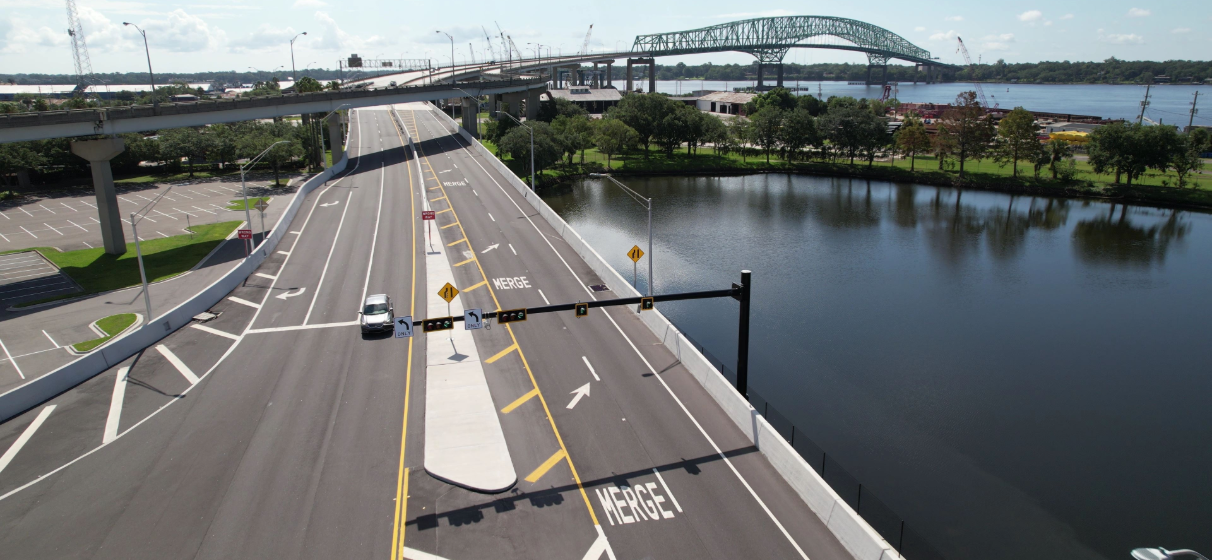
For more than 50 years, an elevated highway sliced through downtown Jacksonville’s riverfront, shaping how residents and visitors experience the city. The Hart Bridge Expressway’s approach ramps towered over streets near the sports complex and stadium, severing downtown from the St. Johns River and limiting access to one of Jacksonville’s most valuable assets.
“Those old ramps were like a wall,” said Keith Jackson, PE, senior vice president and Florida district manager at STV. “They cut off a part of downtown that should have been thriving. From the start, we saw this as an opportunity to reconnect the city to its river and its neighborhoods.”
City leaders set an ambitious goal: remove nearly three-quarters of a mile of aging elevated roadway and replace it with a street-level solution – without disrupting daily commuters, major events or downtown businesses. The effort aimed to improve traffic flow and safety in the sports complex district while unlocking waterfront land for parks, development and public spaces. Achieving all three would require careful planning, technical precision and close coordination.
STV was selected by the City of Jacksonville to lead the project’s design and engineering efforts. The firm assembled a multidisciplinary team to guide the project from preliminary design through final engineering and construction support. Their work included developing demolition plans for the viaduct, designing the new at-grade boulevard and intersection to replace it and supporting the city during construction with traffic planning and field expertise.
Design teams met regularly with City engineers and agency partners to resolve technical issues in real time so that the new roadway integrated smoothly with the surrounding street network.
Rebuilding the Street Grid
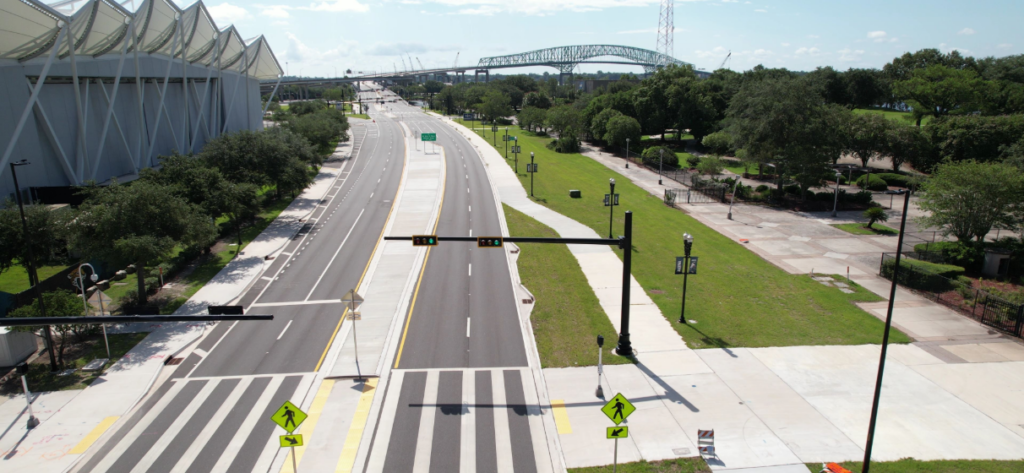
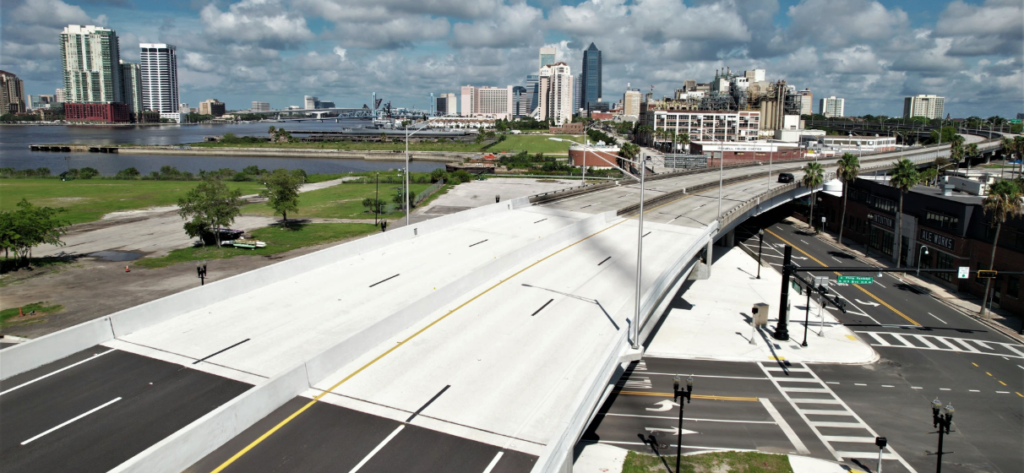
Early in the process, the team developed a plan to thread a street-level roadway through the space left by the removed ramps. This approach extended Gator Bowl Boulevard (near the stadium) directly into Bay Street, reconnecting two major corridors that had long been separated.
Instead of carrying drivers over downtown on isolated flyover ramps, the new configuration brings traffic to a signalized intersection at street level. Vehicles coming off the Hart Bridge now enter the city grid naturally, while local drivers and event-goers gain direct, intuitive access to the sports complex and riverfront.
“What had been a bypass became a city street again,” Jackson said. “That shift changed how people move through downtown and how they experience it.”
Midway through the project, delivery requirements shifted from a design-build approach to a traditional design-bid-build model. STV adapted quickly, advancing the project from 30 percent design to full construction documents on a fast-track schedule. Close coordination with the City and the Florida Department of Transportation (FDOT) helped maintain quality and consistency despite tight timelines.
“We didn’t have the luxury of overthinking every decision,” Jackson said. “We had to bring the right people together, make smart calls and keep moving forward.”
Because the project was funded by federal resources through a local agency program (LAP), its delivery required extensive coordination among various jurisdictions and stakeholders. STV collaborated closely with the City of Jacksonville, FDOT, the United States Department of Transportation (USDOT), the Federal Highway Administration and local leaders to facilitate environmental reviews, historic preservation investigations and agency approvals. The team also handled permitting with FDOT and the St. Johns River Water Management District, coordinated utilities and right-of-way transfers and supported the city in its successful USDOT BUILD grant application. During construction, STV continued to provide support as conditions evolved – including quick, unplanned adjustments to maintenance-of-traffic plans when the nearby stadium was temporarily converted into a drive-through coronavirus testing site.
Technical Ingenuity Under Pressure
Replacing an elevated highway with a street-level corridor in a dense urban setting presented significant engineering challenges. The former ramps carried four lanes of high-speed traffic nearly 40 feet above ground. Their removal required careful regrading, new drainage systems, roadway tie-ins and structural evaluations – all within a constrained footprint bordered by major venues and private development.
For engineers on the project, this meant rethinking grades, stormwater flows, retaining systems and utility conflicts block by block. The team used 3D modeling and high-precision surveys to map existing conditions and test design scenarios before construction began. This digital groundwork enabled new roadways and walls to be installed with minimal disruption.
Structural specialists also analyzed the remaining portions of the Hart Bridge approach to confirm they could safely accommodate new traffic patterns and loading conditions.
Maintaining traffic flow throughout construction was another priority. Demolition and reconstruction had to be staged carefully to keep downtown accessible, particularly during major sporting and entertainment events. STV’s traffic engineers developed a phased Maintenance of Traffic plan that balanced safety, mobility and construction efficiency, sequencing lane closures and detours to minimize impacts.
A New Horizon for Downtown
Today, the Hart Bridge Expressway transformation has reshaped Jacksonville’s downtown landscape. Where a looming overpass once dominated the streetscape, a landscaped roadway now operates at street level, complete with crosswalks, traffic signals and pedestrian-friendly design features.
The change has restored physical and visual connections between the urban core and the riverfront, creating new development and public use opportunities.
Transportation performance has improved as well. Drivers exiting Hart Bridge now disperse at a conventional intersection, easing congestion and eliminating the high-speed merges that once defined the area. Modern safety features help calm traffic, while pedestrians and cyclists benefit from a more accessible, human-scaled environment.
“It’s incredibly rewarding to see how removing that old structure has opened up the area,” Jackson said. “By solving a complex engineering problem, we helped Jacksonville reclaim a piece of its downtown and set the stage for future growth.”