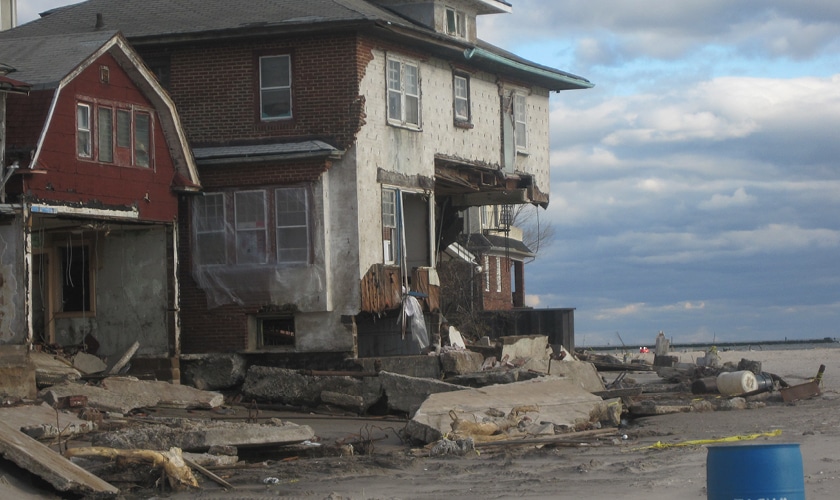
As coastal and inland communities experience more frequent and severe storm events, the ability to quantify and communicate the value of resilience investments is critical for infrastructure owners and operators. For one major rail maintenance and dispatch facility, STV’s team of engineers, economists and planners developed a comprehensive benefit-cost analysis to evaluate a suite of flood mitigation measures.
The analysis drew on guidance from the Federal Emergency Management Agency (FEMA) and the U.S. Department of Transportation (USDOT) to quantify how targeted infrastructure improvements can reduce risk, protect essential transit services and safeguard community access to jobs, education, and opportunity.
In this roundtable, Patricia Macchi, vice president, director of infrastructure economics and grants advisory is joined by Thomas Redstone, AICP, senior economist; Hana Shuck, AICP, economist; and Jack Greenberg, PE, project manager, to discuss how data-driven methodologies and interdisciplinary coordination strengthen the case for resilient transportation infrastructure.
Patricia Macchi: This project combined economic modeling, engineering design and stakeholder engagement. What made it such an effective case study for resilience planning?
Jack Greenberg: It was the perfect intersection of critical need and measurable impact. The facility in question supports regional rail operations, so even a short-term disruption would affect hundreds of thousands of daily riders. Its low-lying location made it especially vulnerable to flooding from storm surges and heavy rainfall.
Thomas Redstone: By combining FEMA and USDOT methodologies, we were able to quantify how targeted improvements could reduce those risks in terms of infrastructure damages avoided and in terms of service continuity and community benefits.
Patricia Macchi: How do you measure resilience into something tangible that agencies can measure or act on?
Hana Shuck: Typical hazard mitigation benefits amount to the damages that are avoided. For hazard mitigation projects aimed at protecting critical site functions and preventing operational disruptions, we consider benefits that extend beyond the project’s immediate location.
In this instance, we examined a resilience benefit known as “loss of function,” which encompasses the broader impacts of disrupted transportation services. These may include longer travel times or lost productivity. By also accounting for social and environmental outcomes, such as reduced emissions, lower congestion and maintained mobility for essential workers, we transform resilience into something agencies can meaningfully measure and utilize in prioritization and decision-making. This approach shows how protecting transportation assets ultimately preserves access and opportunity for the communities that depend on them.
Jack Greenberg: Within that framework, engineering and economics have to evolve together. We looked at perimeter flood protection and drainage as an integrated system since that is how the project is designed. However, we also needed to confirm that each element provided its own independent utility, meaning each component was justifiable and beneficial even if implemented separately. That rigor strengthens the technical design while also making the business case for investment more defensible.
Patricia Macchi: Why is that same level of collaboration so critical at a stakeholder level?
Hana Shuck: Defining the baseline of what happens if no action is taken requires input from multiple partners. For a regional transit facility, this includes agencies that oversee operations, maintenance and emergency response, among other responsibilities.
Thomas Redstone: When all project stakeholders participate in shaping the assumptions and reviewing the methodology, there’s greater transparency and buy-in. That shared understanding is what turns a technical analysis into a decision-making tool.
Patricia Macchi: How do you see these insights shaping decision-making at the agency and community levels?
Thomas Redstone: Resilience planning is about supporting continuity of service and access to opportunity. The benefit-cost framework we used can be applied anywhere: to rail facilities, bus depots or other public infrastructure.
Hana Shuck: Exactly. It helps agencies compare alternatives objectively, prioritize funding and communicate the return on investment to the public. This highlights the importance of collaboration between engineers and economists.
Jack Greenberg: The best resilience solutions come from engineers, economists and planners working hand in hand. That’s how we deliver infrastructure that withstands future storms and communities that stay connected through them.