The modernization of rail maintenance facilities has accelerated rapidly – bringing electrification, automation and data-driven operations into environments once defined by purely mechanical systems. But amid this progress, a critical aspect of facility performance is still too often overlooked: how supporting systems interact under real operating conditions. When coordination across power, communications and safety infrastructure falls short, the consequences can ripple across daily operations, affecting both equipment performance and the people responsible for maintaining it.
In this edition of The Better Question, Christian Alvarez, senior systems engineer at STV, explains why integration is much more than a finishing touch – it’s the operational backbone that allows modern rail facilities to work safely and efficiently while supporting the teams who keep them running.
Myth: Control systems are shaped by the facility’s design and should be addressed in the later stages of design and construction to maximize results.
Where did this idea come from, and why does it still stick?
Controls, schemes and sequences of operations are often invisible. You can see a fan, generator or switchgear, but not the system or network of systems that determine how these function together. In many fast-paced design-build environments, the focus naturally shifts to the physical equipment and infrastructure, often isolating critical systems, trades and yard operations from one another.
When controls are treated as an afterthought, critical functions (such as emergency shutdown procedures) may be overlooked, incompatible equipment may be procured and smart-building capabilities that were intended to be easily implemented may never be fully realized. As a result, projects can experience redesign delays, unreliable communication protocols and misinterpretation of system data and intended smart-facility functionality.
What does the actual evidence tell us?
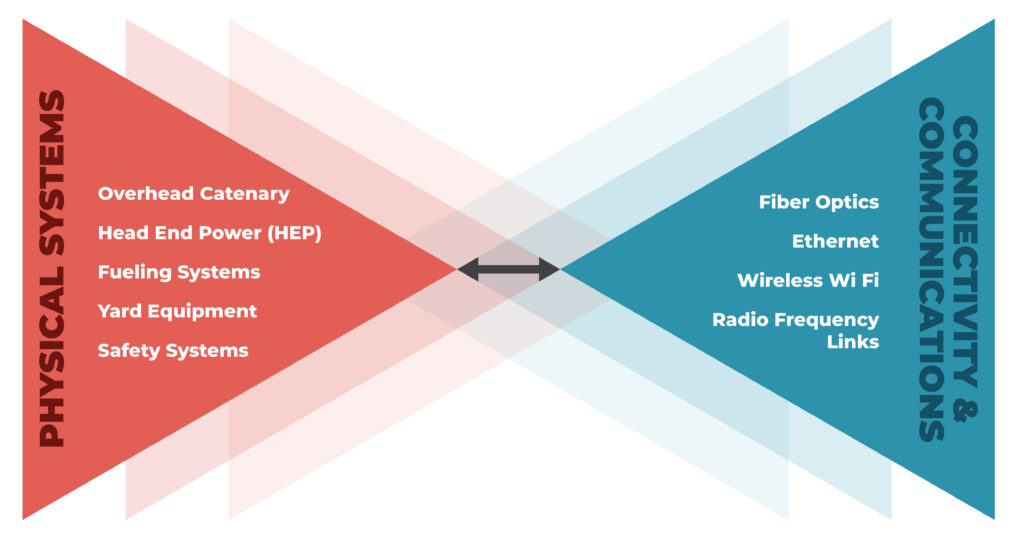
The implementation of interlocking systems for typical maintenance and service yard facilities (such as electrified overhead catenary systems, fueling systems and Head-End Power) helps create safer working environments and improve operational efficiency by coordinating how systems respond under both normal and emergency conditions.
For instance, an interlocked system can automatically de‑energize overhead catenary and disable Head‑End Power when personnel enter a designated maintenance zone, while simultaneously preventing vehicle movement and fuel dispensing until the area is cleared, reducing the risk of accidental energization, allowing crews to work more efficiently without relying on manual lockout procedures.
How does STV approach this challenge?
STV embeds controls and system integration from day one through close partnership with facility staff and operations leads.
- Early alignment with the end user. Supervisory Control and Data Acquisition (SCADA), Virtual Building Management Systems (VBMS) and Electrical Power Management System (EPMS) should reflect operational realities from the outset. STV works directly with yard personnel and discipline leads to define functional requirements before equipment decisions are made, ensuring systems support real workflows – not assumed ones.
- Systemwide compatibility review. All system components (including HVAC units, switchgear, generators, fuel systems and other critical equipment) must communicate within a unified controls architecture that supports interoperability, scalability and long-term maintainability.
- Clear functional specifications and sequence-of-operations logic. STV defines the required actions needed for emergency events, the order in which they must occur and the stakeholders (including emergency responders) who rely on this logic to support safe, coordinate operations and reduce the risk of costly redesigns.
- Integrated network and cybersecurity planning. Internet of Things (IoT) Solutions for Smart Facilities through SCADA systems implementation requires secure and resilient network infrastructures. STV develops integrated network and topology architectures that support industry-leading IoT standards and cybersecurity measures, enabling system automation and reliable real-time data monitoring and reporting.
What does this look like in practice?
For one repair shop’s upgrades, every piece of electrical, mechanical and safety equipment can operate within a unified SCADA framework: creating a safer, smarter and more reliable maintenance environment designed in lockstep with operational needs.
For such an operationally complex yard, this means integrating everything into a single, coordinated system that improves situational awareness for operators and streamlines decision-making for supervisors and emergency personnel.
This gives operators a real‑time, system‑wide view of conditions, replacing fragmented signals with clear, actionable insight.
If owners want smarter, data‑driven facilities but design teams are laser-focused on speed and cost, what question could reveal the shared goal?
Instead of:
“What equipment do we need for the new facility?”
Ask:
“Are we designing buildings, or designing integrated systems that can actually operate safely, efficiently and intelligently?”
Because in modern facilities, success is determined by how everything works together – and how seamlessly people can work within it.
Learn how STV’s systems team can support a feasible, integrated and future‑proof controls strategy for your next maintenance or operations facility.