For decades, the U.S. 1 bridge over the Loxahatchee River served as the primary connection between Jupiter and Tequesta. But as traffic volumes grew and the structure aged, the crossing became increasingly constrained. The bridge lacked dedicated facilities for pedestrians and bicyclists, offered limited navigational clearance for marine traffic and required frequent openings that interrupted travel on both the roadway and the water.
Those operational limitations made replacing the bridge less about building a new structure and more about maintaining mobility across one of northern Palm Beach County’s most important transportation corridors.
That challenge fell to the Florida Department of Transportation, which set out to replace the aging crossing while maintaining access for motorists, boaters, businesses and residents throughout construction. As prime construction engineering and inspection (CEI) consultant, STV helped guide one of the region’s most complex transportation projects from construction through testing and final delivery.
Building Through a Constrained Coastal Corridor
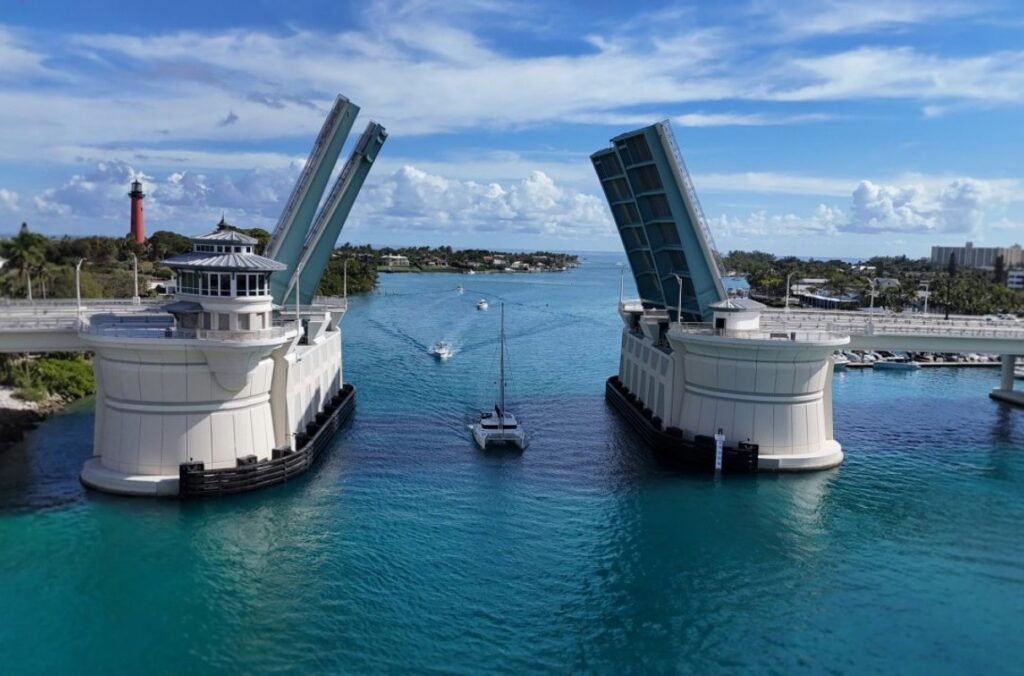
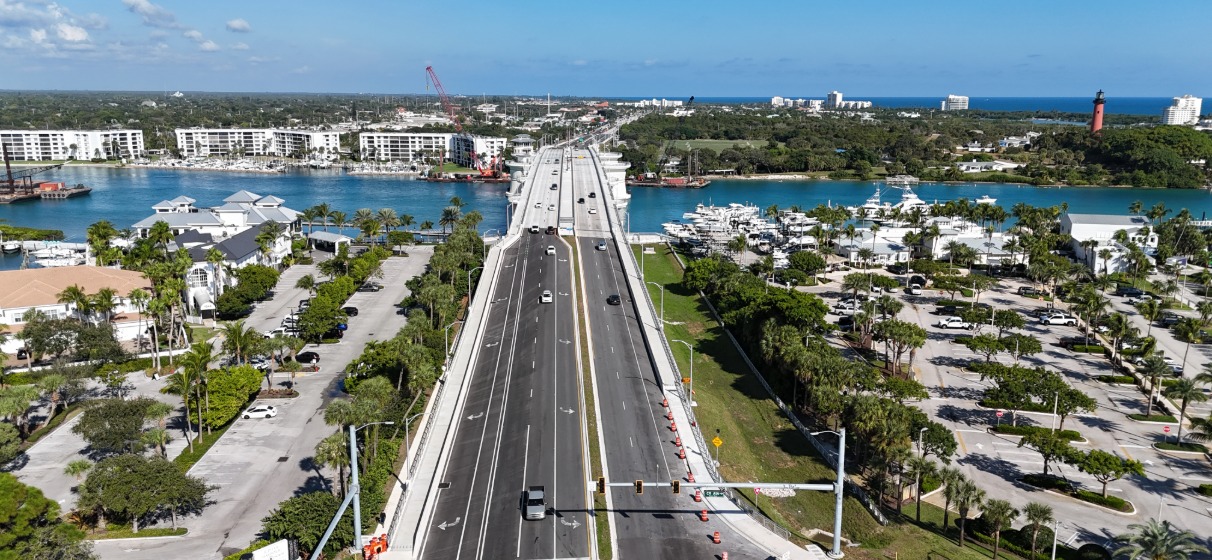
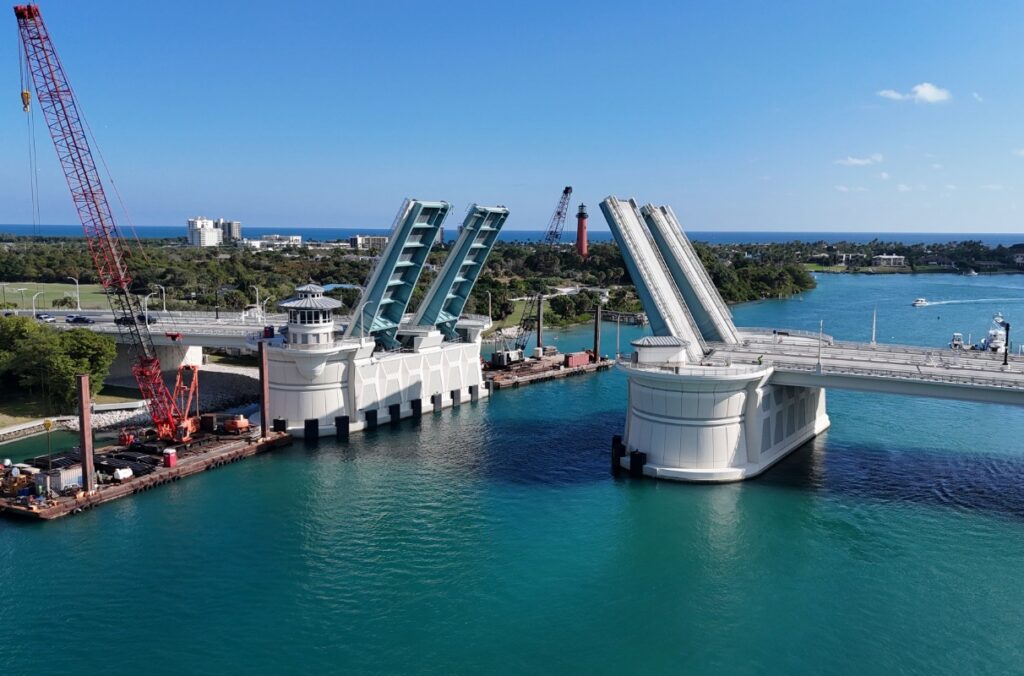
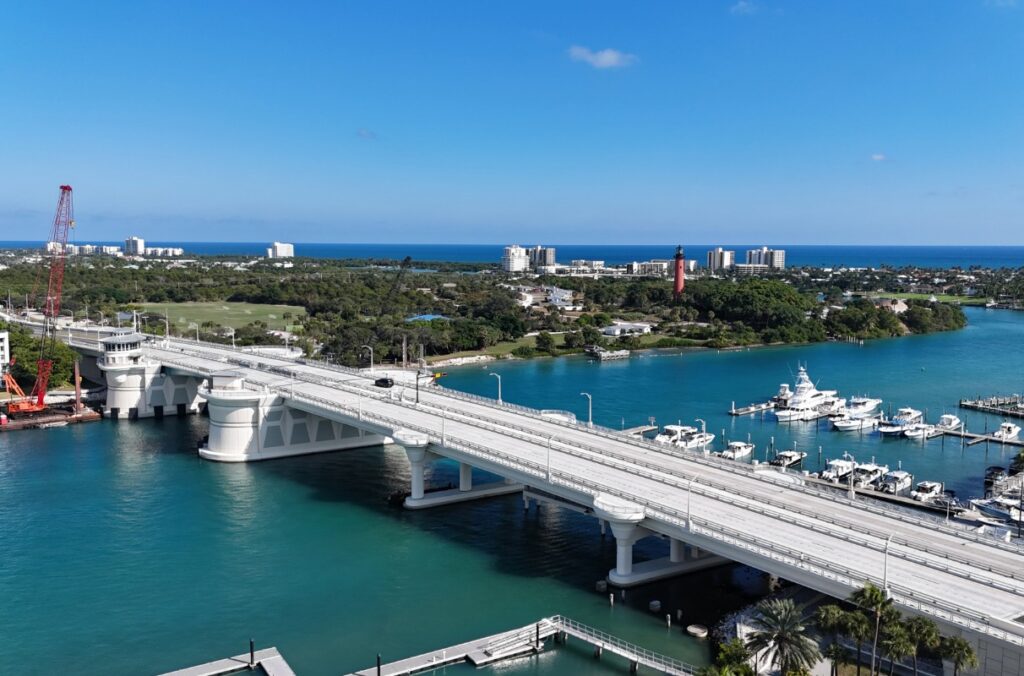
The replacement bridge spans 915 feet across the Loxahatchee River and includes a 267-foot twin double-leaf trunnion hydraulically operated bascule span. The crossing accommodates four travel lanes, dedicated bicycle facilities, sidewalks while significantly increasing navigational clearances for marine traffic. Horizontal clearance expanded from 90 feet to 125 feet, while vertical clearance increased to as much as 42 feet at the center of the channel.
Meeting those goals requires navigating a construction environment with little room for error.
The project team determined that a traditional phased reconstruction would extend construction and create additional operational challenges. The existing bridge was partially rehabilitated by STV and Florida Draw Bridge (FDI- Maintenance Personnel) to increase the service life in order to eliminate the need for a temporary bridge during the construction phase. Alignment of the new bridge was based on the existing bridge configuration to facilitate traffic control during new bridge construction., FDOT implemented a hybrid staging strategy that combined early offline construction, a temporary full bridge closure and a later traffic shift onto completed portions of the new structure while remaining work continued. The approach reduced the overall schedule by an estimated 18 months compared with a fully phased construction sequence.
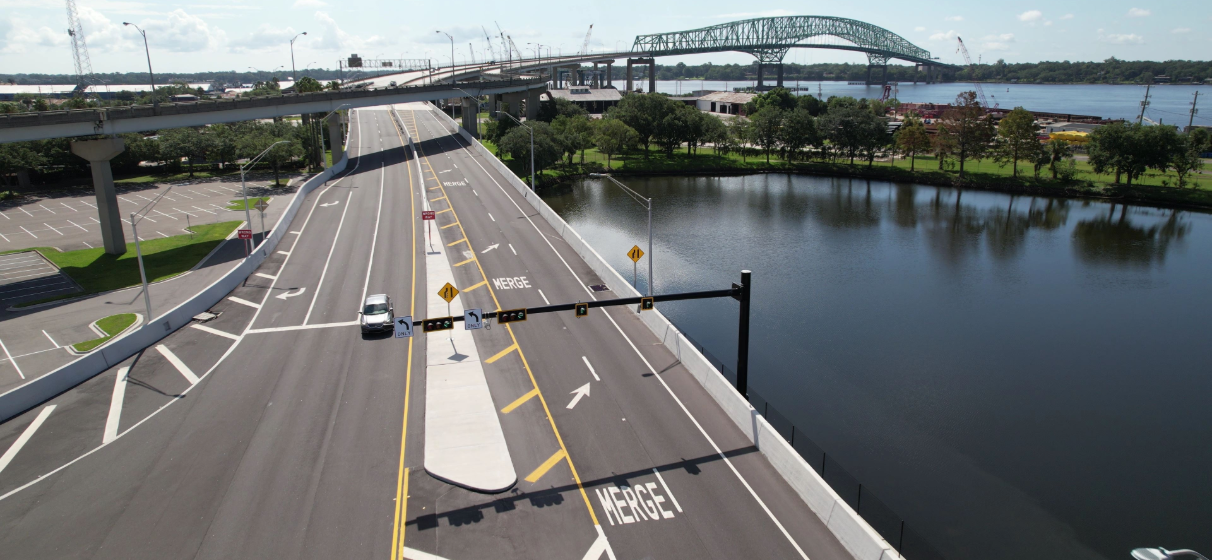
The closure itself presented another challenge. The bridge is a critical transportation link, and roadway detours had the potential to create significant disruption across the surrounding network. To manage those impacts, FDOT deployed a Smart Work Zone integrated with the Palm Beach County Traffic Management Center. Dynamic message signs, Bluetooth travel-time monitoring, CCTV cameras and adaptive signal operations enabled real-time traffic management throughout construction.
“The transportation challenge extended well beyond the bridge itself,” said Keith Jackson, PE, senior vice president and Florida district manager at STV. “We had to think about the corridor as a system and anticipate how construction decisions would affect traffic patterns, emergency access and daily travel throughout the community.”
Inspection at the Intersection of Structure and Machinery
While the bridge appears straightforward from a distance, movable bridges function as highly sophisticated mechanical systems.
The new span incorporates hydraulic machinery, barrier-mounted span locks, advanced electrical controls and a multi-level control house designed to improve visibility for bridge operators. Safety systems include LiDAR motion detection and thermal imaging cameras that prevent operation when movement is detected on the bridge and improve visibility during low-light conditions or adverse weather.
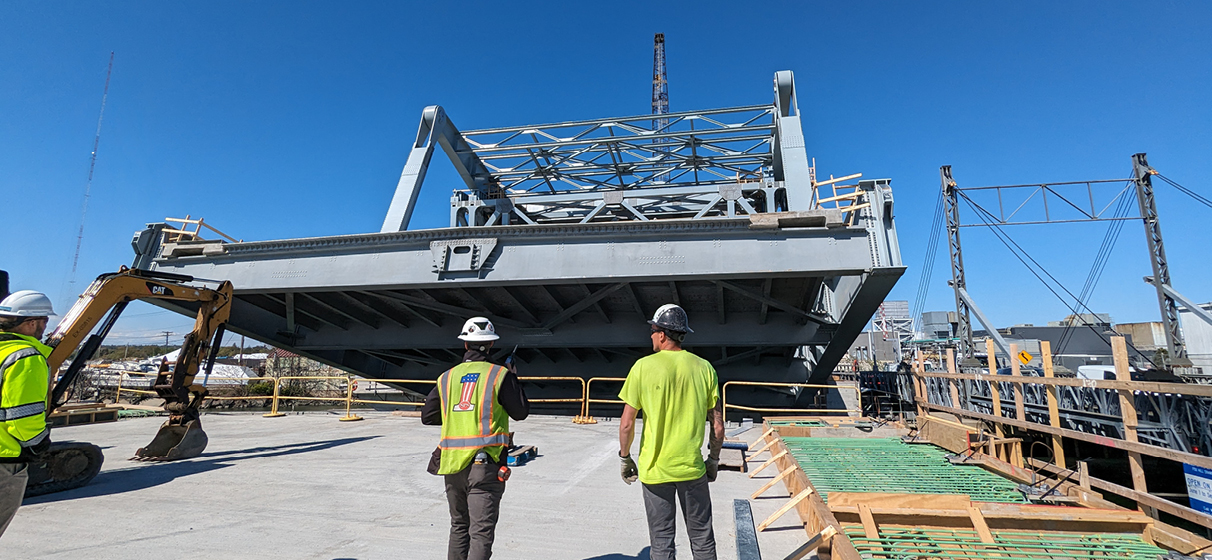
As the prime CEI consultant for FDOT District Four, STV oversaw bridge construction, roadway improvements, utility relocations, intelligent transportation systems, drainage and mechanically stabilized earth walls. In addition to field oversight, STV provided specialty power distribution, control system, overall lighting and low voltage control, HVAC, fire protection, fire alarms and bridge mechanical system installation and alignment CEI support, STV later assisted with hydraulic functional testing, generator reviews and factory acceptance testing and field troubleshooting activities to help verify system performance before final delivery.
“A movable bridge is really the coordination point between multiple disciplines,” said Jorge Leon, PE, vice president and movable bridge group lead at STV. “The structural, mechanical, hydraulic and electrical systems all must work together exactly as intended. Verifying that integration was a major focus throughout delivery.”
Protecting Historic and Environmental Resources
The bridge also sits within one of the most environmentally and historically sensitive locations in Palm Beach County.
Adjacent resources include seagrass habitat, residential neighborhoods and the historic Jupiter Inlet Lighthouse Museum. Construction methods therefore had to balance progress with environmental protection and vibration control.
Foundation construction included approximately 267 prestressed piles supported by vibration monitoring, turbidity controls and specialized installation techniques designed to reduce impacts to nearby resources. To preserve the lighthouse, drilled shafts were selected because they generated less vibration than conventional alternatives. Engineers also incorporated post-grouting techniques that improved capacity while shortening foundation elements.
The project also required coordination with major utility providers, including subaqueous relocations involving Florida Power & Light and Florida Gas Transmission, adding another layer of complexity within an already constrained corridor.
A Crossing Built for How Jupiter Moves Today
The most visible outcome is a bridge designed around a broader range of users.
The improved marine channel provides one of the project’s most significant long-term benefits. Increased horizontal and vertical clearance is expected to reduce bridge openings by roughly 44 percent, helping minimize interruptions for both roadway traffic and vessels. The operational improvement directly addresses one of the most persistent challenges associated with the previous crossing.
The bridge also supports a broader range of users. Where the previous crossing offered no dedicated bicycle lanes or sidewalks, the new structure includes barrier-separated eight-foot sidewalks and buffered bicycle lanes that support multimodal travel across the river. Pedestrian overlooks, decorative lighting and Riverwalk connections further integrate the bridge into the surrounding waterfront experience.
For residents, businesses and visitors, the result is a more resilient connection between Jupiter and Tequesta. For boaters, it is a more efficient passage through one of South Florida’s most active waterways. And for pedestrians and cyclists, it is a connection that simply did not exist before.
The completed project has also received broad industry recognition. In 2026, the bridge received the American Council of Engineering Companies (ACEC) Florida/FDOT Outstanding Bridge Project Award, the American Society of Civil Engineers (ASCE) Palm Beach Branch Project of the Year Award, the Florida Transportation Business Association Best in Construction Award in the Major Bridges category and Engineering News Record (ENR) Southeast’s Best Project award for highways and bridges.
Lessons Beyond Jupiter
The Jupiter Bascule Bridge replacement highlights an increasingly common challenge for transportation owners: modern infrastructure projects rarely fit within a single discipline. Success depended on coordinating roadway operations, marine navigation, environmental protection, utility relocations, structural construction and advanced bridge systems as a single integrated program. For agencies facing similar challenges, that coordinated approach may be the project’s most valuable lesson.
“Projects like this demonstrate the importance of coordination from the beginning,” Jackson said. “When transportation, environmental and operational considerations are treated as part of the same challenge, owners are in a much better position to deliver infrastructure that serves communities for decades.”