For years, Rockville High School’s aquaculture program operated out of a shared garage and mechanics-shop area, limiting both the aquaculture curriculum and the school’s automotive program. As student interest in agricultural science and natural resources continued to grow, Vernon Public Schools recognized that the program needed more than additional tanks or equipment. It needed a dedicated home designed around the way students learn.
That need reflects a broader evolution taking place across Connecticut’s Agricultural Science and Technology Education (ASTE) system, which combines classroom instruction with hands-on learning, leadership development and career exploration. Rockville High School’s program was the first ASTE program of its kind in Connecticut and is now bolstered by the incorporation of aquaculture and natural-resource education into the state’s agricultural science curriculum. As demand grows for workforce pathways in environmental science, food production and natural resource management, schools are increasingly investing in specialized learning environments that allow students to apply scientific concepts in real-world settings.
At Rockville High School, the goal was not only to expand the program but also to create a living classroom where students could move seamlessly from instruction to experimentation while developing skills connected to future academic and career opportunities.
As owner’s representative and project manager, STV helped Rockville High School translate an ambitious educational vision into a specialized aquaculture facility that supports both classroom instruction and hands-on scientific learning. Working closely with educators, district leadership, Connecticut’s Department of Education as the grant funding agency and the design-build team, the project focused on aligning the physical environment with the program’s instructional objectives, ensuring the facility itself became an active part of the learning experience rather than simply a place where learning occurs.
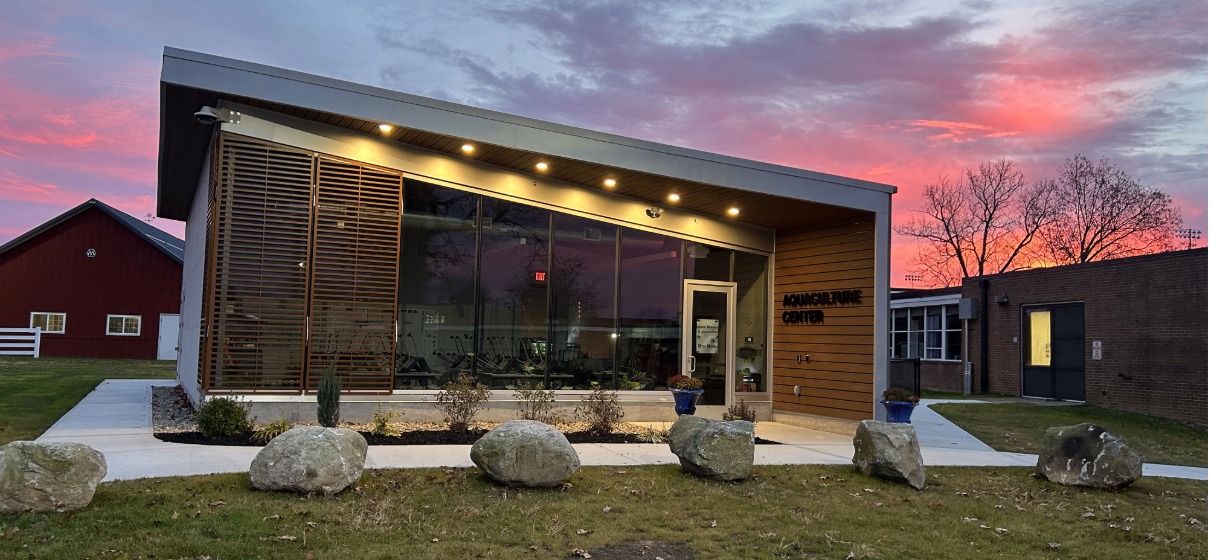
The resulting 1,600-square-foot laboratory was designed as a stand-alone addition adjacent to the existing ASTE wing, providing a seamless connection between traditional classroom space and a highly specialized wet laboratory. This approach allowed students to move easily between instruction and experimentation while minimizing disruption to school operations and providing flexibility for future program growth.
“From the beginning, the focus was on creating a facility that directly supported the district’s educational goals,” said Angela Cahill, project executive with STV. “The building itself is relatively compact, but there was nothing simple about aligning the curriculum, specialized equipment, budget requirements and occupied-campus construction into one coordinated program. Our role was to make sure every decision supported the learning experience students would have once they walked through the door.”
Unlike a traditional classroom project, the aquaculture laboratory required infrastructure tailored to highly specific educational needs. Program requirements called for laboratory spaces capable of supporting freshwater, saltwater and production systems, along with utilities and equipment to accommodate water testing, breeding programs, fish husbandry and related coursework.
The resulting environment was designed to support experiential learning, giving students the opportunity to observe biological systems firsthand, collect and analyze data and immediately apply concepts discussed in the classroom. Classroom space, laboratory casework, production tanks, ornamental systems and marine habitats were all planned around those educational objectives.
Today, the laboratory houses roughly 20 aquatic systems, ranging from small aquariums to industry-style production tanks up to 500 gallons. Students work with species that include tilapia, tropical fish, amphibians, reptiles and freshwater stingrays, providing hands-on exposure to a range of ecological and aquaculture concepts.
Those experiences mirror the experiential-learning model at the core of Connecticut’s agricultural education programs, which emphasize applying classroom knowledge through practical, career-connected learning opportunities.
The project also required careful coordination throughout construction. Because work occurred on an active high school campus, maintaining separation between students and construction activities was a constant priority. Rather than renovating the former shared space, the project team pursued a stand-alone building solution that reduced disruption, preserved school operations and provided greater flexibility for future program growth.
“On paper, it’s a 1,600-square-foot addition,” said Kyle Rongey, senior project planner with STV. “In reality, almost every week involved coordinating something unique, whether it was equipment layouts, fish-tank requirements, technology infrastructure, furniture installation or making sure educator feedback was incorporated without affecting schedule and budget. Those details are what ultimately make the facility work.”
That educator involvement became one of the project’s defining characteristics. Rather than designing around a standardized laboratory model, the project team worked directly with program leadership to understand how instruction, animal care, research activities and daily operations would intersect within the facility.
The facility allows students to learn concepts in a traditional classroom environment and immediately apply them in the adjoining laboratory. The arrangement supports Vernon’s broader Agricultural Science and Technology Education program, which combines classroom instruction with leadership development, industry credentials, supervised agricultural experiences and college-credit opportunities.
Beyond classroom instruction, the project strengthens the school’s ability to prepare students for careers in environmental science, aquaculture, food production, natural resource management and related industries. It also accommodates a program that has experienced substantial enrollment growth over the past decade.
That connection between education and workforce readiness is becoming increasingly important as schools, higher-education institutions and industry organizations seek new ways to develop talent in science, environmental stewardship and food-production fields. By creating opportunities for students to engage directly with living systems, the facility helps connect academic learning with real-world applications and future career pathways.
“The most successful educational facilities do more than house programs. They help create opportunities for students to explore interests, build skills and imagine future career paths,” Cahill said. “At Rockville High School, the facility was designed to support the curriculum while giving students a space where learning can happen through direct experience. When a project aligns educational goals, community investment and student opportunity, the impact extends well beyond the building itself.”