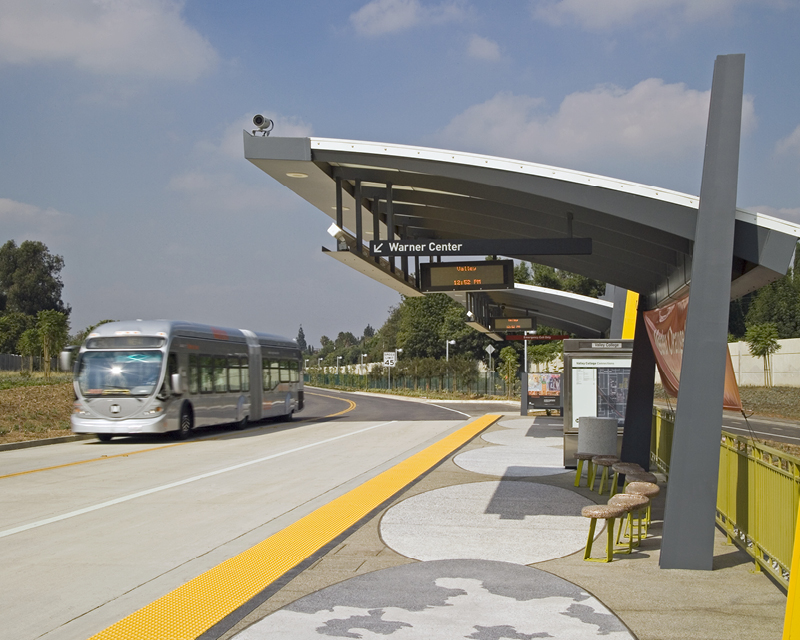
As cities across the West prepare for continued growth and a series of major global events – including the 2028 Olympic and Paralympic Games – transportation agencies need to deliver faster, more reliable mobility within tight funding and right-of-way constraints.
Bus Rapid Transit (BRT) is emerging as a new tier of service, bridging the gap between local bus and rail while offering the flexibility cities need to respond to both everyday demand and extraordinary peak conditions.
STV has been at the forefront of BRT delivery in the West – including providing preliminary engineering and other services for Southern California’s first dedicated BRT system, the G Line in Los Angeles, and the firm’s current role preparing designs for the Westside Cities Council of Governments Quick-Build Bus Infrastructure Program.
In this roundtable, Ryan Shimizu, BRT senior design manager, and Gene Kim, vice president and district manager at STV, discuss how BRT is reshaping mobility in the West and why it is becoming a cornerstone of major-event readiness.
Why are cities in the West increasingly turning to BRT as a transit solution?
Gene Kim: Rail megaprojects are not going away, but the reality is that rail has become extremely expensive to build in the West. That cost, combined with long delivery timelines, has pushed cities and transit agencies to look for lower-cost, high-performing transit solutions that don’t require a billion-dollar investment to deliver meaningful results.
At the same time, there’s been a confluence of factors that have opened up the space for major arterials to be thought of differently. For decades, the focus was on maximizing vehicle throughput. We’ve largely hit the ceiling on how much more we can squeeze out of that approach. Cities now recognize that alternative modes of travel are a critical part of the solution. Additionally, rapidly advancing mobility technologies such as intelligent transportation systems (ITS), next‑generation transit signal priority (TSP), and emerging connected‑vehicle capabilities are reshaping how agencies manage and optimize major corridors.
BRT sits at the intersection of those realities. It allows cities to improve mobility, equity and access within the infrastructure they already have.
Ryan Shimizu: From an implementation standpoint, BRT often becomes the most realistic option when you look at cost, schedule and constructability together. In Los Angeles, we simply don’t have the right-of-way or the tolerance for large-scale rail construction wherever improved service is needed.
With BRT, agencies can work within existing streets using quick-build tools and approaches such as restriping, targeted geometric plans and lane reallocation. That ability to deliver improvements quickly and pragmatically is especially important when cities are planning for major events that have fixed deadlines and intense peak demand.
Where does BRT fit within the broader transit network?
Gene Kim: Buses are often underappreciated, but they are the workhorse of transit in most metropolitan regions. While commuter rail, light rail and high-speed rail all play important roles, the real backbone of transit is local and increasingly limited-stop bus service.
What’s often missing is the in-between layer – a service that’s faster than a local bus but more flexible than rail. BRT fills that missing middle. It provides a higher-quality experience that people typically associate with rail, while retaining the adaptability of rubber-tire transit.
This flexibility is critical not just in dense urban areas where rail expansion is limited, but also in smaller and mid-sized cities – college towns, suburban corridors and activity centers – where BRT has proven highly effective.
Ryan Shimizu: That’s why BRT is often described as “light rail on wheels.” From the rider’s perspective, it feels like a premium service. From an agency perspective, it’s adaptable. Rail can’t be rerouted easily; BRT can respond to changes in land use, demand and even event locations. That makes it particularly valuable as cities plan for both daily commuting and major surges in travel demand.
How does street design and the concept of “complete streets” support BRT?
Gene Kim: I credit planners with helping develop a new framework for how streets should function – one that places walking, cycling, active transportation, transit and private vehicles on more equal footing. This notion of a complete street is now deeply embedded in how cities think about their corridors.
That means being very intentional about how space is programmed: dedicated transit lanes, class IV bike lanes, larger pedestrian zones and safer curbside environments. Within that context, transit – and particularly BRT– becomes a central organizing element of the street.
Ryan Shimizu: In practice, that often means redesigning space that was previously dedicated to on-street parking or general traffic. These are sensitive decisions because you’re effectively redesigning someone else’s street, but they’re necessary to improve transit performance, especially in dense corridors where demand is already high.
How do funding constraints shape BRT design and delivery, especially for major events?
Gene Kim: Funding realities have driven a shift toward quick-build, lower-cost treatments. Many BRT projects focus on restriping, targeted geometric improvements, and signal upgrades rather than full reconstruction. These approaches allow cities to deliver improvements faster and stay within constrained budgets.
For major events, speed matters. Cities need infrastructure in place early enough to test, refine and operate it reliably before the event arrives.
Ryan Shimizu: Funding and schedule constraints force agencies to prioritize high-impact improvements that can be delivered quickly and cost-effectively. The Westside Quick-Build Bus Infrastructure Program exemplifies this approach, focusing on targeted bus-priority treatments like striping and lane reallocation ahead of the 2028 Olympic and Paralympic Games. It’s a clear example of aligning BRT design with solutions that are both adaptable and deliverable under tight timelines.
Why is BRT so critical to major-event readiness in cities like Los Angeles?
Gene Kim: Not all major venues are located near rail stations, and that’s certainly true for LA28. But Los Angeles has an extensive roadway network, which makes it an ideal setting for rubber-tire, dedicated bus service.
BRT and bus-priority treatments allow cities to move spectators from park-and-ride hubs or rail stations directly to venues. We’re already seeing a generational shift in how people think about this. Examples like the Dodger Express and the Hollywood Bowl shuttle service show that people are comfortable using bus-based services for major events.
The most important thing is that these investments create huge legacy benefits. What starts as an event-driven improvement often becomes a permanent enhancement that serves residents long after the event is over.
Ryan Shimizu: In dense cities like Los Angeles, major events create sharp traffic spikes that the roadway network can’t absorb through private vehicles alone. BRT addresses that challenge by shifting large numbers of people out of individual cars and into high-capacity, reliable transit that can operate effectively even when surrounding streets are heavily congested.
From a delivery standpoint, BRT allows cities to implement, test and refine operations before demand peaks. That operational readiness is critical for global events, and it leaves behind proven infrastructure and experience that continue to reduce congestion and improve mobility long after the event is over.
Looking ahead, how do you see BRT evolving in the West?
Gene Kim: We’re starting to see the network effects of BRT: moving beyond individual corridors to integrated systems that connect with rail, mobility hubs and transit-oriented development. People are beginning to understand that BRT is a permanent investment that can change behavior, reduce car dependence, and support major activities and events.
Ryan Shimizu: In Los Angeles and across the West, BRT is quickly becoming one of the most effective tools we have for improving mobility within tight constraints. These projects are setting the foundation not just for major events, but for how cities move people for decades to come.