In Dispatches from 2050, STV practitioners examine global pilot cases to understand how long-horizon infrastructure decisions unfold over decades and how our communities might follow similar trajectories.
Nearly everything we consume touches a railroad at some point on its journey. That’s been true for nearly two centuries. What’s changed is the pressure on the system: anticipated rising freight volumes, aging assets, workforce constraints and a logistics landscape that demands real‑time coordination across modes.
Railroads have survived for 200 years because they adapt. They are private, operationally disciplined and (though often overlooked) technologically advanced. Modern freight railroads already deploy machine learning for inspection, routing and predictive maintenance. What slows progress is not technology itself, but the friction at interfaces – between ports and rail, agencies and operators, capital programs and live operations. Integration, not innovation, is the constraint.
So, what happens when a region treats freight as a coordinated system?
Stretching from the Port of Rotterdam through Germany and Switzerland into northern Italy, the Rhine-Alpine Corridor is one of the busiest freight routes in the world. Over the past two decades, European agencies, port authorities and private rail operators aligned around a shared goal: to make rail the default long‑haul freight mode by removing friction at every operational, regulatory and data interface.
Ports invested in on‑dock rail and digital yard management. Rail operators modernized clearance‑constrained tunnels and terminals. Governments focused on facilitating interoperability by standardizing signaling, data exchange and cross-border operating rules, aiming for 6% annual growth in rail freight volume by 2030. Labor concerns around automation were addressed early, through workforce transition programs embedded into capital planning, rather than deferred until technology forced the issue.
The result is not an overnight transformation, but steady, compounding systemwide gains in reliability, capacity, and carbon performance.
This kind of long‑horizon coordination reflects how STV approaches freight advisory work: by understanding how corridors, terminals, ports and communities function as interconnected networks and by shaping decisions that respect live operations while planning for decades-long outcomes – not isolated assets or single delivery phases.
Once freight is framed as shared economic infrastructure, alternative delivery models became easier to test. Data sharing moved from pilot to practice because governance and accountability were addressed alongside technology, not after it.
If we start with that premise, what might the freight system in the U.S. look like by 2050?
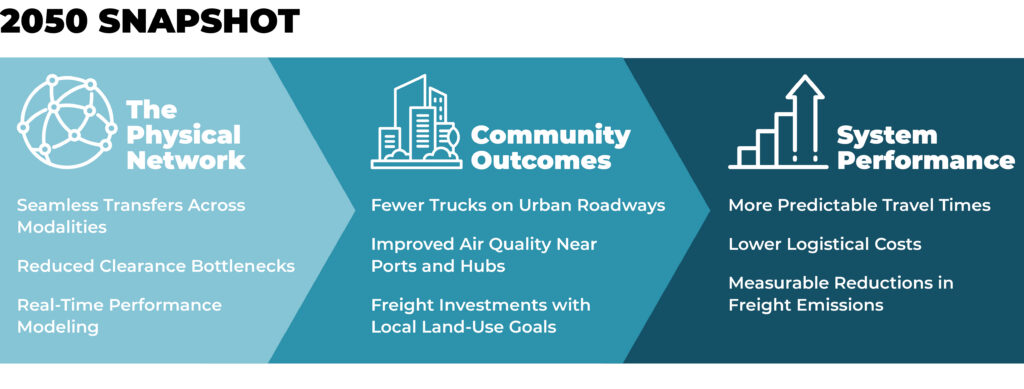
- Delivery Models Matter. Complex freight environments require construction and program management that respects live operations.
- Policy as a Facilitator. When governments remove barriers and align incentives, private systems can operate more effectively.
- Long‑Horizon Planning Wins. Multi‑decade roadmaps create certainty for capital investment and workforce planning.
So, How Do We Get There?
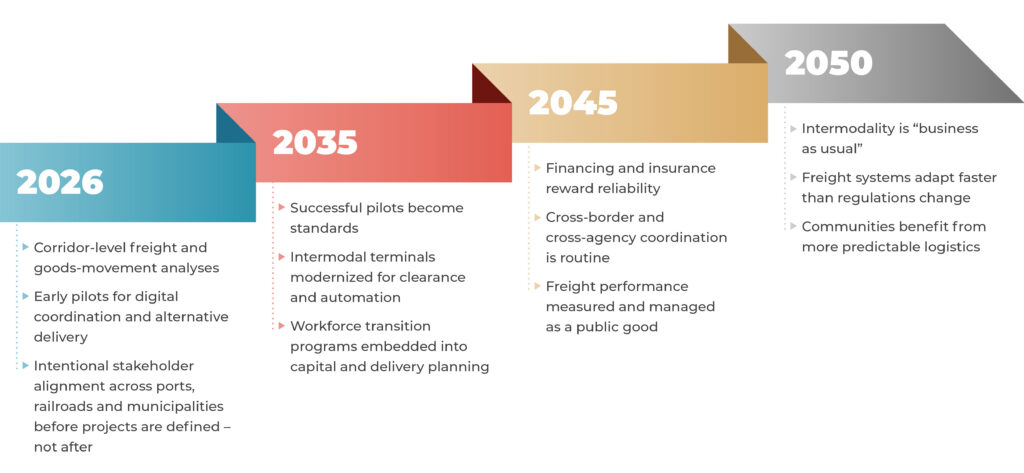
Where is this already emerging?
Early signals of this shift are already visible in the U.S., where select freight initiatives are beginning to prioritize corridor-scale system performance over individual asset ownership.
Efforts such as the Cross Harbor Freight Movement Program show how public agencies can convene railroads, ports and municipalities around shared reliability and mobility outcomes. Programs like the Howard Street Tunnel Clearance Program demonstrate how targeted public investment can unlock private freight capacity while respecting live operations and community constraints.
Across these efforts, project scoping timelines are compressing, and labor and technology considerations are entering earlier in planning. Agencies are increasingly acting as facilitators of coordination – setting the conditions for systems to work – rather than attempting to manage freight through ownership alone.
Together, these shifts suggest a gradual move toward treating freight as shared economic infrastructure. It lays the groundwork for more integrated, resilient systems that evolve over time rather than react to crises.
When agencies stay nimble, and the industry shares data while testing new models, the shared responsibility across agencies, communities, and operators can ultimately turn pilots into scalable systems.
Learn more about how STV is partnering with clients to plan and deliver freight systems that strengthen connections in our communities.