In infrastructure design, one of the biggest challenges engineers face is the ground beneath our feet. Soil and rock layers aren’t always consistent. Some may be firm and stable, while others are soft, weathered, loose or highly sensitive to external forces. Designing foundations that can safely support structures in these conditions requires both geotechnical experience and engineering judgment, particularly as infrastructure programs increasingly move into more constrained and geologically variable corridors.
That challenge was front and center on a recent highway reconstruction project where saprolite – a soft, clay-rich, decomposed rock – defined the design environment. By leveraging micropile foundations and aligning design decisions with construction realities, our team delivered a solution that balanced performance, managed subsurface uncertainty and improved quantity predictability in highly variable ground conditions.
Understanding the Ground: Why Saprolite Changes the Equation
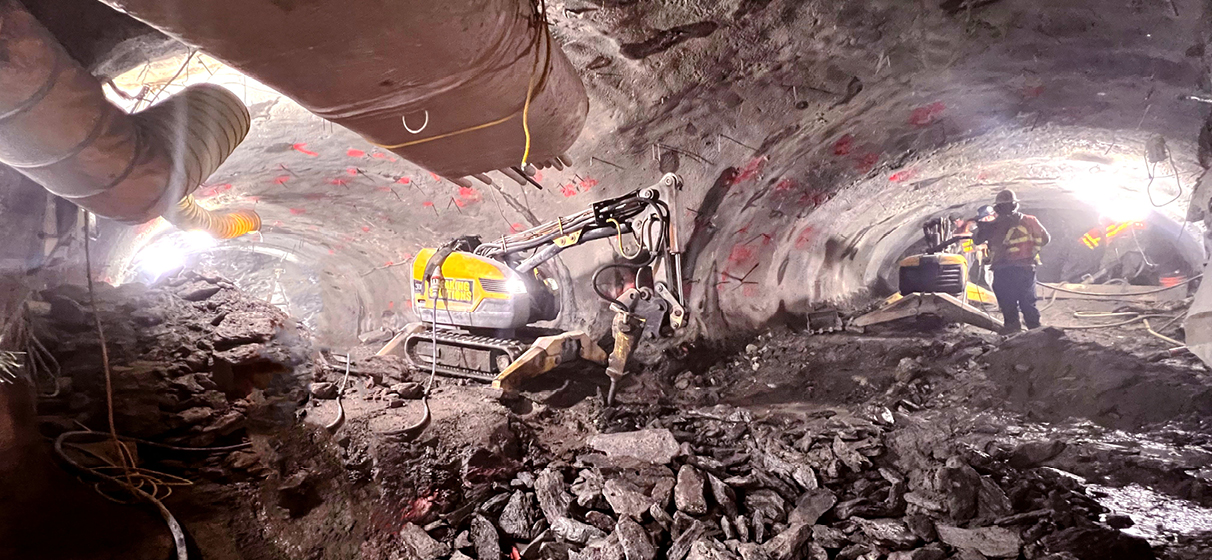
In many urban corridors, infrastructure sits atop a transitional geologic layer where chemically weathered rock overlies competent bedrock. Saprolite occupies that space. It behaves partly like soil and partly like rock – dense and stiff when confined, but susceptible to raveling or collapse when exposed, depending on moisture and degree of decomposition.
What makes saprolite especially challenging is its variability. Depth to competent bedrock can fluctuate significantly across a site, while the top of the saprolite layer may remain relatively consistent. If not properly accounted for, underestimating this variability can lead to settlement, serviceability issues and costly remediation.
On this project, understanding how saprolite behaved across the site allowed us to make a targeted design decision – incorporating an uncased micropile length within the saprolite. This approach provided reliable load transfer while reducing reliance on deeper casing assumptions, which improved confidence in material quantities and procurement planning.
Why Micropiles Were the Right Tool
Micropiles are small-diameter, drilled deep foundations that transfer load through bond with the surrounding ground. Their flexibility makes them well-suited for constrained sites, low-headroom conditions and projects where minimizing vibration is critical.
For this reconstruction effort, micropiles allowed us to address both geotechnical uncertainty and constructability considerations:
- Vibration Control: Installation methods minimized vibration, protecting nearby residences and adjacent infrastructure.
- Load Transfer in Variable Ground: Bonded lengths were designed to account for changes in saprolite strength while supporting vertical and lateral demands from retaining walls.
- Durability: Steel casing and corrosion protection were sized for long-term performance in aggressive ground conditions.
- Group and Lateral Performance: Detailed analyses ensured micropile groups could safely resist lateral forces for walls reaching up to 33 feet in height.
- Safety and Verification: Test pile reinforcement was intentionally upsized to allow higher test loads without overstressing steel, prioritizing worker safety while confirming design assumptions.
Before full production, field load testing validated performance and reduced uncertainty. Beyond confirming capacity, the testing program provided project-specific performance data that can inform future design approaches in similar ground conditions.
Practical Lessons for Building on Variable Ground
Several best practices emerged from this work that apply broadly to infrastructure in weathered rock environments:
- Invest in Understanding the Ground:
A detailed geotechnical model reduces surprises and provides a clearer basis for design decisions where variability cannot be eliminated.
- Test Early, with Safety in Mind:
Early load testing aligns design assumptions with field performance while reinforcing a safety-first culture.
- Design with the Builder in Mind:
Quantity certainty, material procurement and sequencing matter. Designing for constructability is designing for success.
- Stay Connected Across Phases:
Continuous coordination among designers, owners and contractors helps manage risk as conditions evolve.
By integrating geotechnical investigation, thoughtful foundation design, and rigorous field verification, micropile systems can deliver reliable performance even in the most unpredictable ground conditions. As infrastructure programs increasingly confront subsurface uncertainty, solutions that combine technical rigor with constructability insight will be critical to delivering predictable, long-term performance.