High-speed rail in the United States is often discussed in terms of future possibilities, but the reality is being shaped today through a series of incremental decisions, project milestones and evolving delivery strategies.
To better understand where the industry stands and how major programs are progressing, we spoke with Tyler Bonstead, vice president and engineering director, about what’s happening on the ground and what it means for the future of U.S. high-speed rail.
1. There’s a lot of attention on high-speed rail globally. How does the U.S. compare right now?
The U.S. is still at a different stage compared to countries that have had high-speed rail networks for decades. In places like Spain or China, the conversation is about network expansion or optimization. Here, we’re still working through what it takes to get initial segments delivered and operating.
Part of that is just the reality that we have only a small number of active high-speed rail programs, so progress can feel incremental. But within that, there’s been a noticeable shift over the past several years. Instead of focusing primarily on what a fully built-out system should look like, there’s more attention on what’s achievable in the near term.
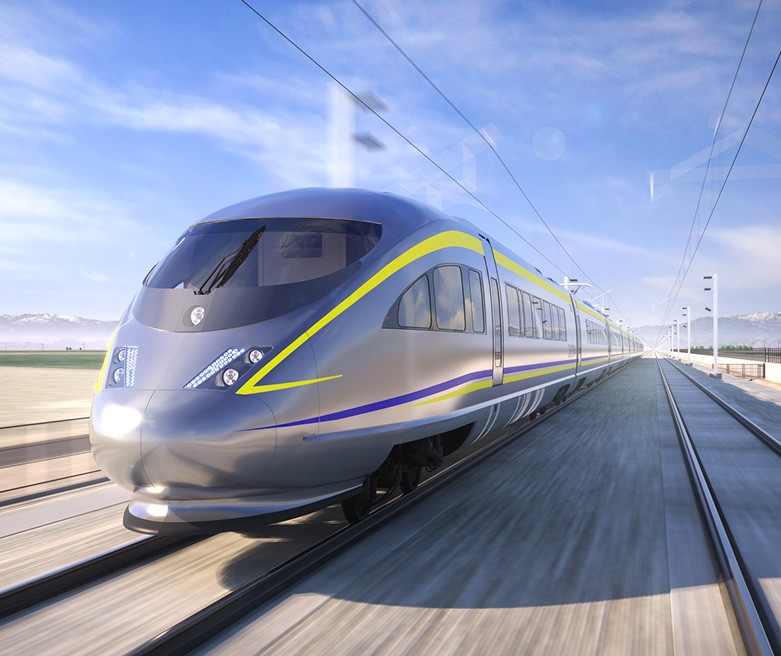
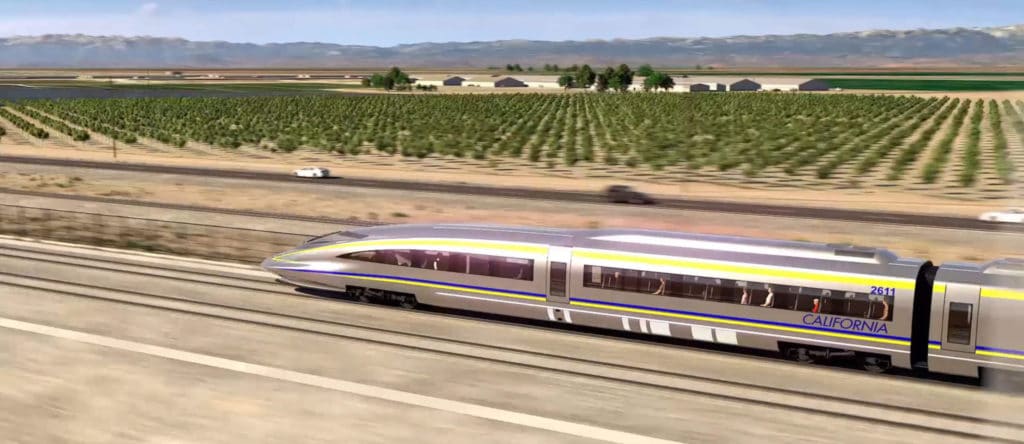
You see that clearly in California. For example, the Central Valley segment of the California High Speed Rail project is something that’s been under construction for years. It’s not the full statewide vision, but it’s a tangible piece of infrastructure that demonstrates progress and helps move the program forward.
At the same time, there’s still a lot of learning from global systems, but those lessons have to be adapted. The regulatory environment, permitting process and funding approach here are fundamentally different, so it’s about translating those ideas into something that works in the U.S. context.
2. What are the most important trends shaping how these projects are planned and delivered?
A big trend is the move toward more flexible, phased delivery. What we’re seeing now is more emphasis on defining what’s needed to get service up and running initially and then building toward the long-term system over time.
That shows up in design decisions. For example, instead of designing every component for ultimate capacity right away, agencies are thinking about how infrastructure can scale. That requires more iteration – refining designs, revisiting earlier assumptions and doing more value engineering to align scope with available funding.
There’s also a shift in how agencies think about financial sustainability. Rather than relying entirely on farebox revenue, there’s more interest in how the system can generate value in other ways. That includes development around stations, retail opportunities and even how the right-of-way itself can be used – for example, accommodating utilities or other infrastructure
Those ideas aren’t necessarily new, but they’re becoming more central to how projects are structured.
3. You mentioned phasing and scalability. How does that show up in real project work?
It becomes very tangible when you look at how individual components are planned.
Take maintenance facilities as an example. For a full statewide system, you need a large, centralized heavy maintenance facility that can handle dozens of trainsets. But at startup, you don’t need that full capacity. So, the approach is to plan a smaller “day one” facility that supports initial operations, while also planning for how that facility expands over time.
We’re seeing that in California right now. There’s work underway to identify and advance sites for a large future maintenance facility that could ultimately support around 60 trains, but in parallel there’s planning for a smaller operations and maintenance facility to support early service in the 2030s.
That kind of layered approach applies across the system. It’s not just facilities: it’s track, structures and systems as well. Everything is being considered in terms of what’s needed now versus what’s needed later.
4. What work is currently underway in California that reflects this approach?
There are a few areas where you can see different phases of California’s high-speed rail program happening at the same time.
In the Central Valley, construction is further along. On Construction Package 1, for example, we’ve been involved in a hybrid role supporting both design and construction management, making sure what’s being built in the field aligns with the design. That initial guideway construction work has been ongoing for close to a decade, and it’s now starting to wrap up.
At the same time, in Southern California, the work is still largely in the environmental and planning phase. On the Los Angeles to Anaheim segment, the draft environmental document was released late last year, and the final document is targeted for completion this year.
What makes that segment particularly important is that once it’s complete, the entire statewide system will effectively be environmentally cleared. That doesn’t mean everything immediately moves to construction, but it removes one of the biggest barriers to advancing projects.
5. The LA-to-Anaheim segment seems to do more than just support future high-speed rail service. Can you explain that?
One of the more interesting aspects of that work is how it supports improvements that can happen before high-speed rail service is fully in place.
As part of the environmental process, there are “early action” projects that have been identified along the corridor. These are improvements that other agencies can advance using the environmental clearance we’re helping to develop.
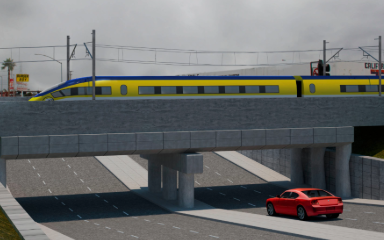
For example, there are planned upgrades at Union Station in Los Angeles, as well as new structures and grade separations that can improve capacity and reliability for existing services like Metrolink and Amtrak.
There are also improvements further down the corridor, including at locations like Fullerton. The idea is that by the time high-speed rail trains are ready to operate in Southern California, much of the supporting infrastructure is already in place.
So even though the high-speed system itself may take longer to fully materialize in that region, the corridor benefits start showing up earlier.
6. What kinds of work do agencies anticipate needing as the program moves forward?
A lot of the work ahead is about refinement and implementation.
Even after environmental clearance, projects still need to be optimized. That includes evaluating designs to reduce cost, simplify construction and align with available funding. We expect to see continued demand for value engineering, design updates and environmental reevaluation as projects evolve.
There’s also a shift in how projects are delivered. For example, some of the upcoming packages in the Central Valley are expected to use design-build delivery in which contractors and designers work more closely together earlier in the process.
And then there are the broader contract mechanisms – like on-call or IDIQ contracts – that agencies can use to access expertise across a range of needs, from design refinements to specialized technical work.
While the focus may shift from planning to construction in some areas, there’s still a large amount of technical work happening behind the scenes.
7: Where do you see the biggest challenges ahead?
One challenge is managing expectations around what progress looks like.
These projects take a long time, and a lot of the most important work isn’t always visible. Environmental clearance, design refinement and procurement strategies don’t necessarily generate headlines, but they’re essential to actually delivering the system.
Another challenge is alignment and making sure that funding, policy decisions and technical planning all move forward together. There are moments where attention shifts, whether it’s to broader transportation legislation or other priorities, and that can affect momentum.
Finally, there’s just the complexity of building this kind of system in an existing environment. You’re not starting from a clean slate. You’re working within existing corridors, existing communities and existing infrastructure, which adds layers of coordination.
8: How should people think about progress in U.S. high-speed rail?
It’s really about repeated small steps forward.
There isn’t going to be a single moment where everything goes from under construction to complete and operational. Instead, you see progress in pieces: a completed structure in the Central Valley, a new higher speed trainset operating in the Northeast Corridor, electrified trains running from San Francisco to San Jose, service from Miami to Orlando, and so on.
Each of those steps builds on the last. They eventually lead to a seamless system, but the process is gradual.
That’s probably the best way to understand where we are today. There’s a lot happening, but it’s happening in layers rather than all at once.
High-speed rail in the U.S. is evolving through a series of practical decisions: how to phase projects, how to fund them, and how to integrate them into existing systems.
While the pace may seem measured, the foundation is being built piece by piece. Over time, those pieces will align into something much larger that is really a game changer for transportation in the United States.