The rapid evolution of automated trucking is moving from pilot-scale demonstrations to real, commercial deployments across 35 states and some of the nation’s most high-volume freight corridors. These deployments are surfacing new expectations around safety, data sharing, digital work zone readiness and multi-state coordination.
With a predicted $7 billion in annual revenue, capturing roughly 8% of the U.S. rideshare market, they’re also accelerating conversations about how infrastructure, technology and operations must evolve together to scale and support Autonomous Vehicle (AV) trucking. What’s becoming clear is that while automated trucks can operate today, targeted investments in infrastructure, data systems and coordination will determine how efficiently and consistently they scale.
For states, this moment represents a shift from experimentation to disciplined, repeatable operations, where shared data, aligned expectations, and corridor-level collaboration become essential public-sector tools.
To explore what this means in practice, STV sat down with Ted Bailey, director of government technology solutions, to discuss how states can prepare now for AV trucking at scale, and why interstate corridors rich in freight activity are primed for this transition.
1. Automated trucking is accelerating quickly. Why are certain states particularly well-positioned to lead the way?
The states that are best prepared for AV trucking share a few characteristics: high freight density, operationally significant long-haul corridors, predictable weather and a streamlined regulatory environment that gives operators clarity around liability and expectations. They tend to be places where agencies, universities, industry partners and first responders have a history of collaborating and where public sector partners have built trust through consistent, data-driven operational practices.
When you combine permissive but accountable legislation with strong Department of Transportation (DOT) leadership and a safety-focused culture, you get the ideal proving ground for transitioning from small pilots to scaled operations. These environments allow states and operators to work as true partners, shaping standards that strengthen both safety and community outcomes.
2. As AV freight scales, where do you see the biggest gaps (and the biggest opportunities) for states?
The most immediate need is strengthening the digital layer of transportation. AV trucks rely on both on‑board perception and high-quality, real‑time data from infrastructure owners and operators. That means states must modernize traffic management systems, digitize work zones, harmonize their data formats and build APIs that allow freight operators to exchange information at scale.
At their core, many of these capabilities depend on a small set of shared operational data streams: incident data, work zones, weather conditions and traveler information that must be consistent across jurisdictions.
Equally important is corridor-level governance. Automated trucking doesn’t work effectively if each state along a major interstate has different expectations for work zone feed formats, enforcement interactions or operational data. We’re already seeing multistate coalitions that span urban, rural and cross-regional freight flows aligning around shared standards and operational frameworks. STV helps agencies establish these frameworks by aligning people, processes and technology around scalable, future-ready operations.
3. What does “corridor readiness” actually mean in the AV context?
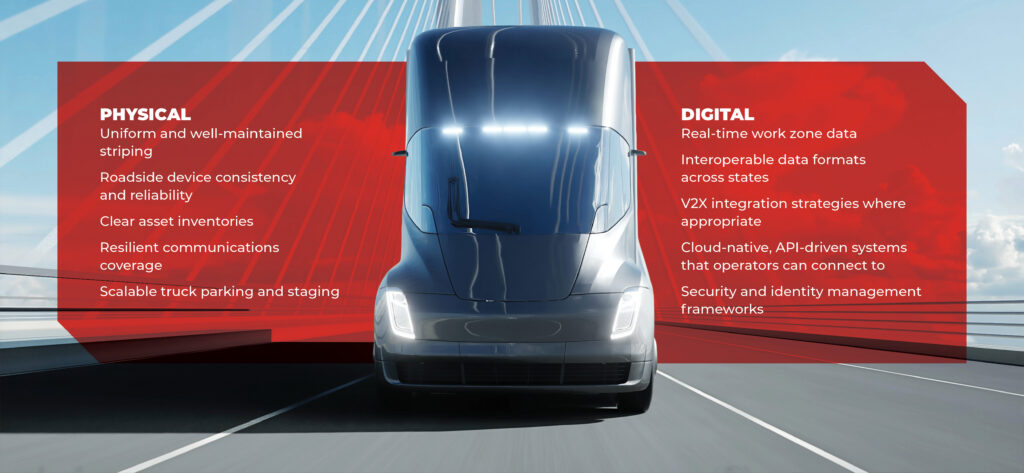
Corridor readiness is both physical and digital. An AV truck’s performance is shaped by the corridor it operates in, making consistency across both physical and digital layers essential for scalable operations.
4. Multi-state coordination keeps coming up as a critical need. Why is it so important?
Automated trucks move across regions. If one state provides excellent work zone data and the next provides none, the operator has to fall back to the lowest common denominator. That creates inconsistent behavior and can undermine public-sector expectations.
Inconsistent information across state lines can directly translate into inconsistent vehicle responses, particularly in work zones and incident conditions.
States that collaborate (sharing truck parking availability, winter weather conditions, work zone notifications, crash or incident feeds and even planned closures) create a seamless operating environment where AV trucks can make safe, consistent decisions. Interstate corridors are where this coordination becomes operational, turning shared data into consistent, real-time decision-making.
5. What’s next for states looking to scale from pilot to real operations?
As technology matures, we’re entering a phase that demands repeatability and accountability. That means establishing shared safety case structures, clarifying enforcement expectations, aligning remote assistance protocols, building scalable corridor-level data exchanges and upgrading traffic management systems to handle a future where trucks are both autonomous and deeply connected.
Equally important is confirming that automated trucks behave in predictable, enforceable ways: particularly in work zones, roadside interactions and incident conditions.
States that take a proactive, coordinated approach to modernizing procurement, strengthening data governance and sustaining cross-jurisdiction collaboration will both accelerate safe deployment and help define national standards. In doing so, they set the stage for freight systems that are safer, more resilient and better connected to the communities that depend on them.