When the New York State Department of Transportation (NYSDOT) initiated the rehabilitation of the 1.5-mile viaduct along the Van Wyck Expressway (I-678), the agency knew it was addressing far more than a structural challenge.
The elevated roadway is one of the most heavily traveled corridors in New York City – an essential link between Queens, Midtown Manhattan and one of the world’s busiest international gateways, John F. Kennedy International Airport. It also serves millions of annual visitors heading to major attractions, including Flushing Meadows-Corona Park, Citi Field and the USTA Billie Jean King National Tennis Center.
To help preserve this crucial artery, NYSDOT contracted with STV to provide resident engineering, construction inspection and office engineering services for a complex, multi-year rehabilitation effort valued at approximately $125 million. The assignment required technical precision, adaptive traffic management and collaborative problem-solving under intense operational constraints.
“You don’t often get a project where every single decision reverberates across a region,” said Robert Vaz, senior construction manager at STV. “On the Van Wyck, even minor lane shifts can affect airport traffic, event access and commuter travel times. That reality shaped every aspect of how we managed construction.”
A Corridor Showing Its Age
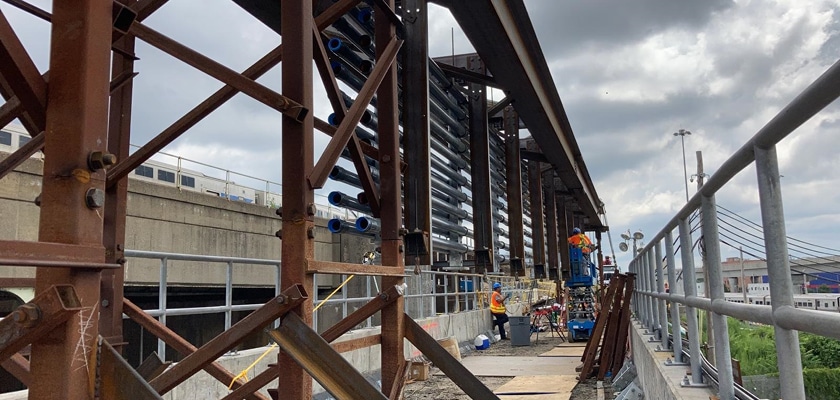
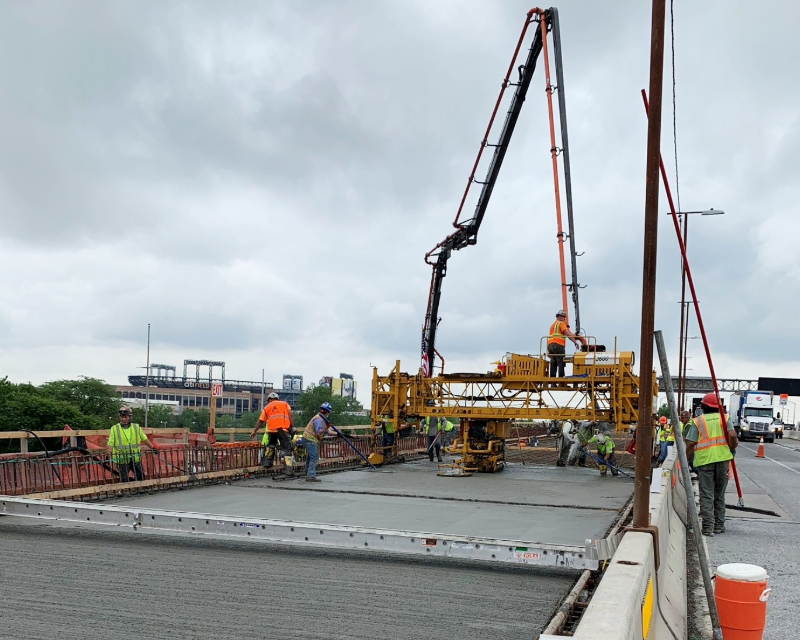
By the time construction began, the viaduct’s deck and substructure were showing significant deterioration – severe in some locations. Over the course of the project, STV oversaw the replacement of more than 236,000 square feet of concrete deck, the rehabilitation of the steel superstructure and concrete substructure, including the full replacement of 18 concrete piers, which required elaborate shoring systems constructed beneath active traffic lanes.
The project design incorporated High-Strength Internal Cure Concrete (HPIC) for pier reconstruction and Ultra-High-Performance Concrete (UHPC) for link slab joints – an approach that eliminates outdated armored joints and reduces long-term maintenance. Accelerated bridge construction techniques enabled entire ramp decks to be reconstructed in a single weekend using precast panels and UHPC closure pours.
“The structural work alone was massive, but the real challenge was doing it while keeping New York moving,” Albert Wong, project manager at STV, said. “That meant constant coordination and a readiness to shift gears whenever field conditions or city events demanded it.”
Engineering Under Pressure: The Demands of Working in a Live Environment
Unlike conventional bridge rehabilitation projects, work on the Van Wyck Expressway occurred in an intensely constrained environment – surrounded by parkland, major event venues and connections to local roads. Daily lane closures required careful sequencing, rapid field decision-making and continuous communication with NYSDOT and local stakeholders.
STV implemented an adaptive Work Zone Traffic Control (WZTC) strategy, assessing traffic volumes, event schedules and real-time conditions to set lane configurations for each work shift. During Mets home games or the U.S. Open, the team adjusted construction activities to preserve consistent travel times.
“It wasn’t enough to follow a baseline closure plan – we had to anticipate the city’s pulse,” Wong said. “Our inspectors and office engineers were constantly assessing conditions on the ground, and we adjusted accordingly to keep traffic, emergency vehicles and event operations running efficiently.”
Innovation Through Collaboration
Early in the project, inspectors identified areas of deterioration that exceeded the original plans’ expectations when repair areas were exposed. Instead of allowing these conditions to create delays, STV collaborated with NYSDOT and the contractor to propose targeted value-engineering solutions – including the removal of unnecessary staging and the resequencing of pier rehabilitation.
STV also deployed digital inspection tools, enabling real-time field reporting and faster issue resolution across construction teams, office engineers, and the owner.
“Good REI work blends technical judgment with agility,” Vaz said. “We used data to drive decisions, and we shared that information quickly so that the contractor and NYSDOT could act without losing momentum.”
Safety and Community Coordination at the Forefront
With tens of thousands of vehicles passing overhead daily, the project required rigorous safety oversight. STV enforced daily site safety inspections, monitored barrier and signage setups, and coordinated with NYPD, FDNY, and NYCDOT to maintain emergency access through tight construction zones.
At the same time, the team delivered consistent access for park users, cyclists and pedestrians while minimizing disruptions to nearby neighborhoods. The project’s visibility along a regional gateway required sensitivity to aesthetics as well: upgraded lighting and unified parapet designs helped improve both roadway safety and visual continuity for millions of annual visitors.
“Projects like this succeed when the community hardly notices the work – but deeply benefits from the results,” Wong said. “Our job was to make sure progress never came at the expense of access or safety.”
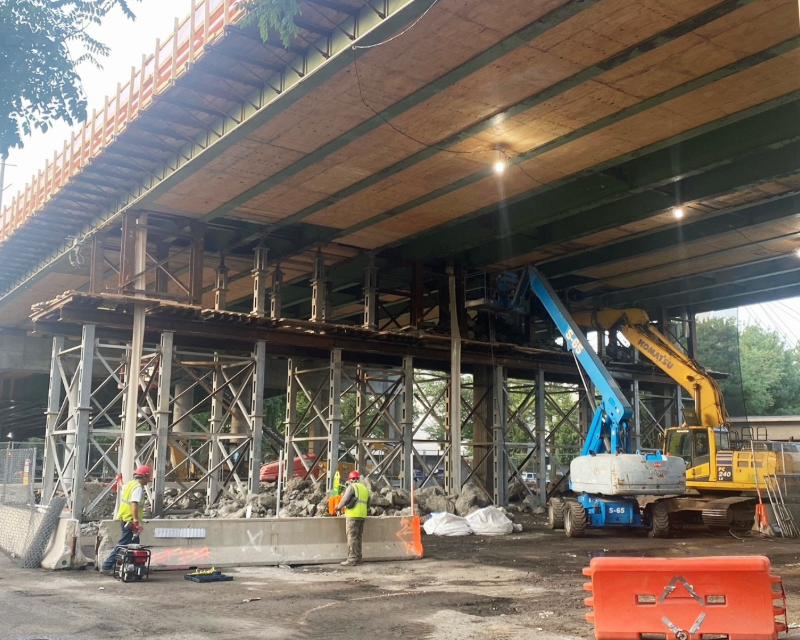
A Renewed Link to New York City’s Global Front Door
Upon completion, the viaduct emerged stronger, safer, and better positioned to serve the region for decades. The project extended the service life of a vital corridor while improving mobility for airport travelers, tourists and local commuters.
The work also demonstrated the power of partnership – among STV, NYSDOT, contractors, local agencies and community stakeholders. The project’s adaptive, data-driven approach now serves as a model for future complex urban rehabilitation efforts across the state.
“This project shows the advantages of pairing engineering precision with flexibility,” Vaz said. “The Van Wyck is a gateway to Queens and to the world, and we’re proud to have helped restore and protect this crucial piece of infrastructure.”