As transportation agencies across the United States design increasingly complex highway alignments, engineers are being asked to solve more than geometric challenges – they’re being asked to deliver long-term performance in constrained, real-world conditions. At STV, that shift has prompted closer examination of how seemingly small structural decisions can influence how bridges behave over decades of use.
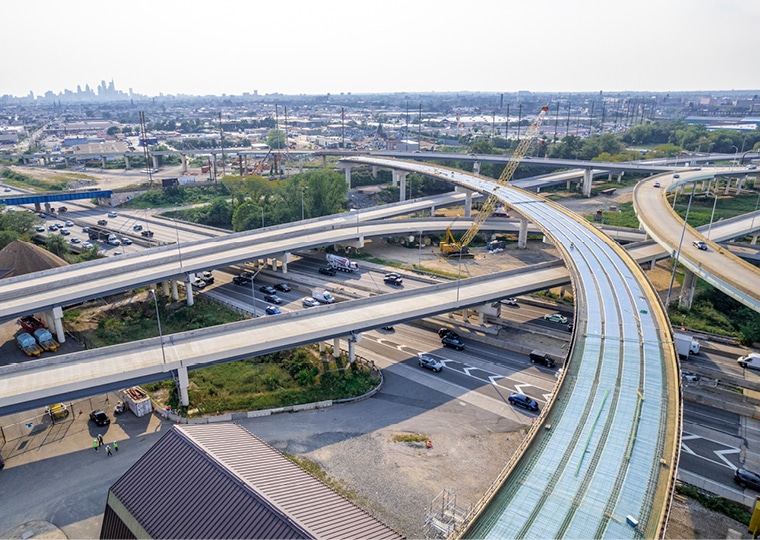
Across the United States, agencies are increasingly turning to curved steel bridges to support highway alignments. These bridges are particularly useful in fast-growing areas where roads must navigate tight spaces, existing infrastructure and challenging terrain.
However, while curved bridges solve important geometric challenges, their shape also introduces structural behaviors that engineers must carefully consider.
Why Curved Bridges Are Different
Unlike straight bridges, curved bridges experience twisting forces as vehicles travel across them. Because traffic does not pass directly through the center of the structural system, loads tend to shift toward certain girders, especially those located along the outside of the curve. This uneven distribution can place greater demand on specific parts of the bridge and requires thoughtful structural design.
To manage these forces, engineers rely on internal framing elements called cross-frames, which connect adjacent girders and help distribute loads across the bridge. Another structural feature, known as bottom flange horizontal bracing, links the lower portions of girders together.
Traditionally, this type of bracing has been primarily used to stabilize the structure during construction. However, in practice, STV engineers have observed that these elements may also influence how curved bridges perform long after construction is complete – an observation that raised important questions about their long-term behavior.
Communities rely on these bridges every day, and across STV’s bridge work nationwide, we see how incremental design choices can have an outsized impact on safety, durability and the everyday commuter experience.
Looking at the Bridge System in a New Way
To better understand how bottom flange horizontal bracing affects real-world performance, STV engineers developed a detailed computer model of a representative curved steel bridge. The goal was not simply to validate theory, but to explore how different bracing strategies might influence load behavior in ways that matter to owners, designers and maintainers.
By analyzing how the bridge responded to typical traffic loads under each scenario, we tested how different bracing layouts affected the distribution of forces and how small changes in bracing design can influence the overall behavior of the bridge system.
This pairing of analytical rigor and practical, design-stage considerations reflects how STV supports agencies in understanding not just what works, but why it works – and how those insights can inform smarter decisions earlier in the design process.
What the Model Found (and Why It’s Actionable)
When bracing was placed near the outer girders, the bridge tended to distribute traffic loads more evenly across the structure. This helped reduce situations in which one girder carried significantly more load than the others, allowing the bridge system to behave more evenly.
The presence of bottom bracing also influenced how forces traveled through the bridge’s internal framing system. Certain components that often influence long-term durability saw lower stress levels when bottom bracing was included. These shifts suggest that the bracing can help the structure better manage twisting forces by altering how loads move through the bridge.
Rather than simply adding strength, the bracing helps the bridge function more as a coordinated structural system. By tying the girders together at the bottom flange level, the bracing improves the overall stiffness of the structure and helps the girders share loads more effectively.
What’s Next in the Design and Research Space
For bridge designers, these findings highlight an opportunity to rethink bracing systems. Instead of viewing bottom flange bracing as a temporary construction aid, engineers can consider how it contributes to the bridge’s long-term behavior. Thoughtfully arranged bracing can help improve load distribution, influence internal force paths and support the overall performance of the structure.
Curved steel bridges are becoming more common as transportation networks continue to evolve. As bridge configurations grow wider and more complex, understanding how different structural components interact becomes increasingly important.
Research grounded in real design challenges helps engineers and agencies refine strategies so bridges not only meet today’s demands but continue to perform reliably for decades to come. By centering long-term value, client partnership and community benefit, STV is helping agencies deliver bridges that are safer, more resilient and better suited to the people who rely on them every day.