Along North Carolina’s rapidly expanding I-77 corridor in the Town of Huntersville, the North Carolina Department of Transportation (NCDOT) faced a common challenge that happens in many fast-growing communities: how to safely and efficiently move increasing traffic through a corridor that was never designed to meet current demand. Closely spaced interchanges, heavy commuter flows and limited right-of-way led to recurring congestion and safety issues at the intersections of I-77, Gilead Road and US 21 (Statesville Road).
To tackle these challenges, STV partnered with local and state stakeholders to rethink how traffic moves through this complex interchange area. Instead of defaulting to traditional widening or signal-heavy solutions, the team turned to innovative intersection strategies – ultimately combining a median U-turn configuration with an adjacent diverging diamond interchange (DDI). The result is a context-sensitive, cost-effective solution that improves operations, boosts safety and provides long-term value for the community.
A Corridor Defined by Competing Movements
During peak evening hours, traffic along northbound I-77 mainly flows away from Charlotte. Many drivers exit at Gilead Road (Exit 23), turn right and then try to make an immediate left onto US 21. Because of the tight spacing between the ramps and the US 21 intersection, this pattern of movements caused a perfect storm of operational inefficiencies.
At its worst, congestion at the US 21/Gilead Road intersection regularly backed up toward the interstate ramps, increasing delays and driver frustration while raising the risk of rear-end and sideswipe crashes. Left-turn movements were especially problematic, leading to an eight-phase signal at the US 21 intersection, while the nearby diamond interchange operated on a simpler three-phase system. Closely spaced, multi-phase signals strained the available green time and limited the corridor’s ability to function smoothly as a cohesive system.
Looking Beyond Conventional Solutions
Recognizing that traditional methods would not sufficiently address the root causes of congestion, STV and the project team assessed various options from the innovative intersection “toolbox.” These included a quadrant roadway intersection, a roundabout and a direct ramp connection beneath Gilead Road.
Each option offered potential benefits but also brought significant constraints. High traffic volumes challenged the feasibility of the roundabout. The proximity of the existing DDI limited how additional intersections could operate without creating new conflicts. Meanwhile, surrounding development in key quadrants constrained right-of-way acquisition and increased costs for more invasive solutions.
This alternatives analysis focuses on identifying a solution that could work within the corridor’s physical constraints while still delivering meaningful operational improvements.
The Power of a Median U-Turn
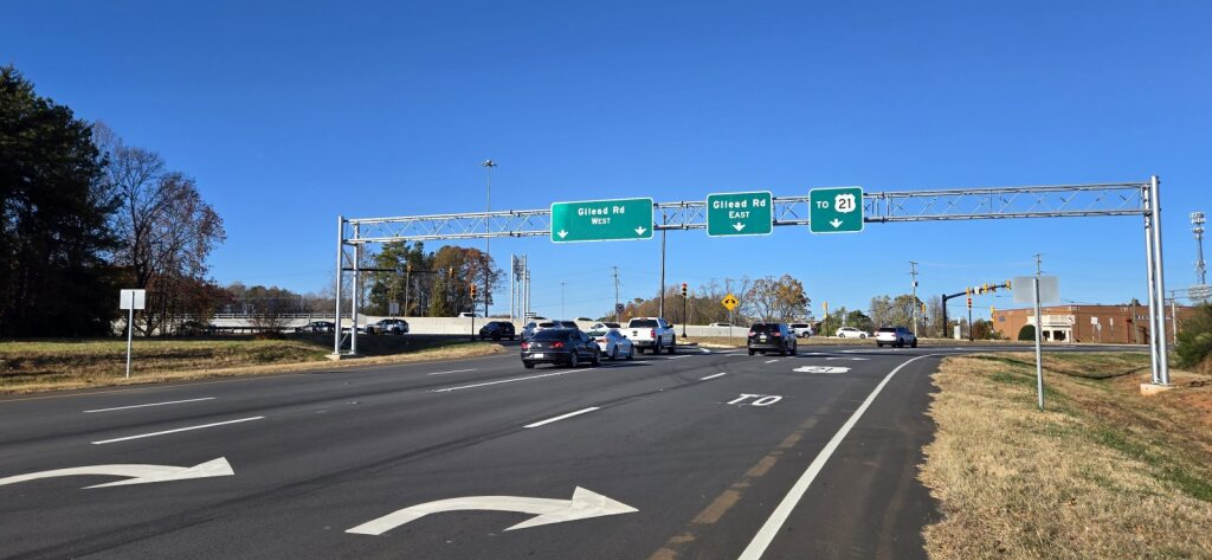
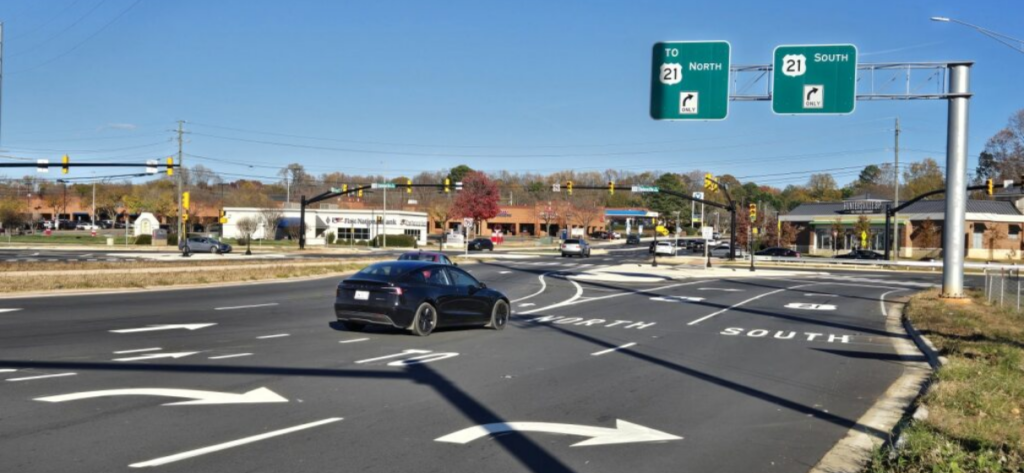
Ultimately, the team selected a median U-turn configuration as the most effective and balanced solution. In this design, vehicles exiting I-77 and turning right onto Gilead Road stay on the right side of the road, continue to US 21 southbound and then make a signal-controlled U-turn instead of making a direct left turn.
Eliminating left-turn movements between the interchange and US 21 fundamentally changed how traffic flows through the corridor. The US 21/Gilead Road intersection was simplified from eight signal phases to only two – aligning it with the nearby DDI and enabling the corridor to operate as a coordinated system rather than as a series of competing intersections.
From an operations standpoint, the benefits were immediate and significant: fewer delays, less conflict points and smoother progression through closely spaced signals. From a safety perspective, removing left turns reduced the most crash-prone movements, helping to create a more predictable driving environment.
Designing for Integration and Durability
Beyond traffic operations, the project required careful design coordination to make sure the new configuration integrated smoothly into the existing corridor. Signal and signing upgrades were deliberately planned to support new traffic patterns and enhance driver decision-making.
Originally, metal strain poles were proposed at the intersection corners, and overhead utilities were relocated accordingly. Later, as a betterment option, the Town requested that the design be upgraded to mast arms, improving both durability and aesthetics. With a 24-foot-wide median available, mast arm poles were installed along the centerline, an uncommon but highly effective solution that utilized the corridor’s geometry while reducing additional roadside impacts.
Advancing Multimodal Safety
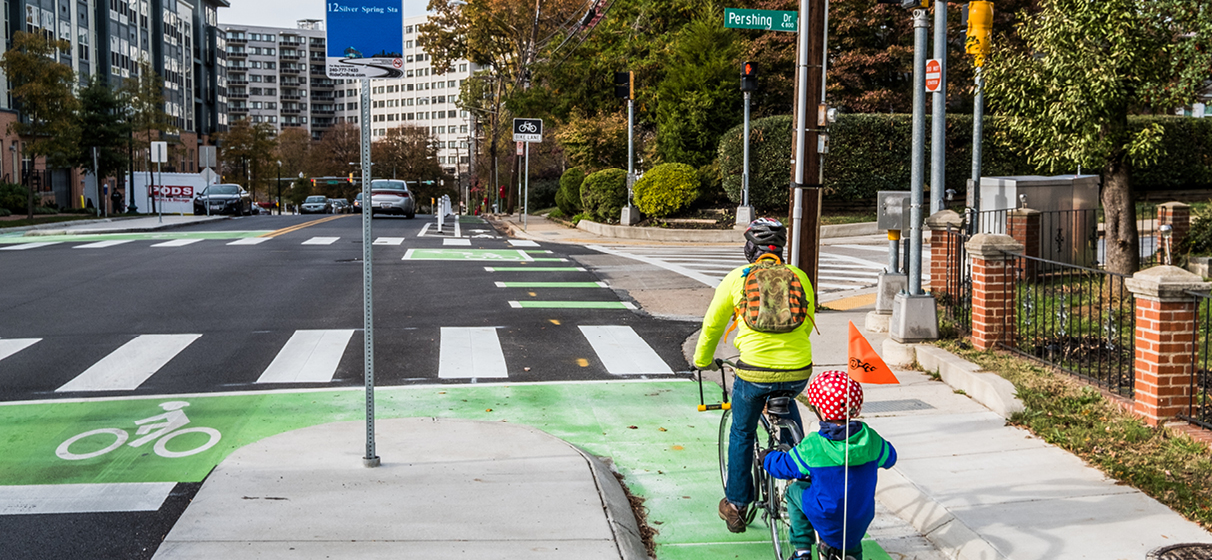
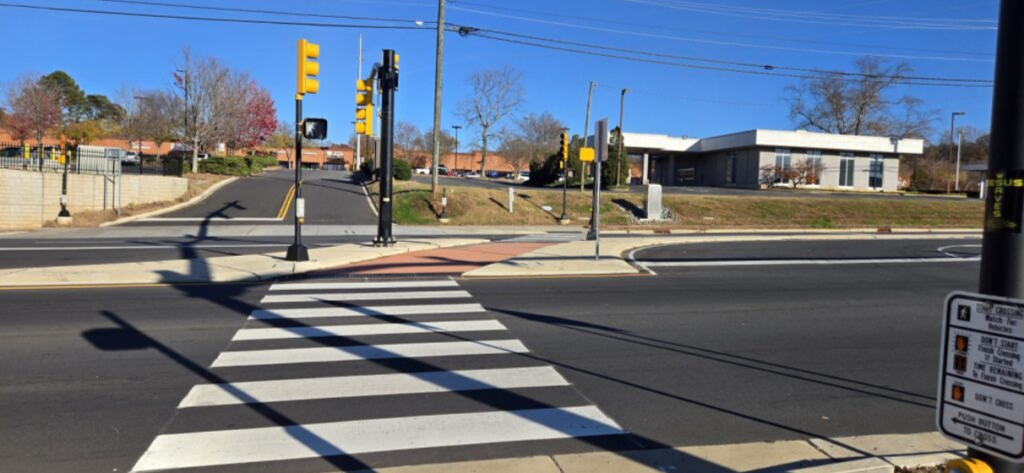
While vehicle operations were a primary focus, pedestrian safety and connectivity were also key considerations. A sidewalk was built within the median between the DDI and the US 21/Gilead Road intersection, enabling pedestrians to cross the corridor without crossing high-speed ramp traffic.
A new crosswalk between a nearby left-turn crossover intersection and one U-turn location further enhanced connectivity and visibility for non-motorized users. These elements demonstrate STV’s commitment to designing transportation systems that accommodate all users – not just vehicles – especially in suburban corridors with increased multimodal demand.
Managing Change and Measuring Success
As is common when traffic patterns change and drivers encounter a new configuration, some initial compliance issues were observed after implementation. These problems were expected and resolved with targeted adjustments, such as additional median treatments to prevent illegal left turns and encourage proper movements.
Over time, driver understanding improved greatly. One year after implementation, the median U-turn and adjacent DDI are operating as intended, resulting in a smoother traffic flow, reduced congestion and higher reliability across the corridor.
A Model for Context-Sensitive Innovation
The project in Huntersville demonstrates how pairing innovative intersection strategies can unlock solutions in environments where conventional designs fall short. Faced with tight spacing, high volumes and limited development options, the median U-turn proved to be a practical and cost-effective alternative that complements the nearby diverging diamond interchange.
For communities facing similar challenges along expanding interstate corridors, this project provides a valuable lesson: innovation is most effective when it is intentional, integrated and rooted in local context. By focusing on how drivers travel – and by designing systems that coordinate rather than function in isolation – transportation agencies can achieve lasting improvements in safety and mobility without excessive construction.