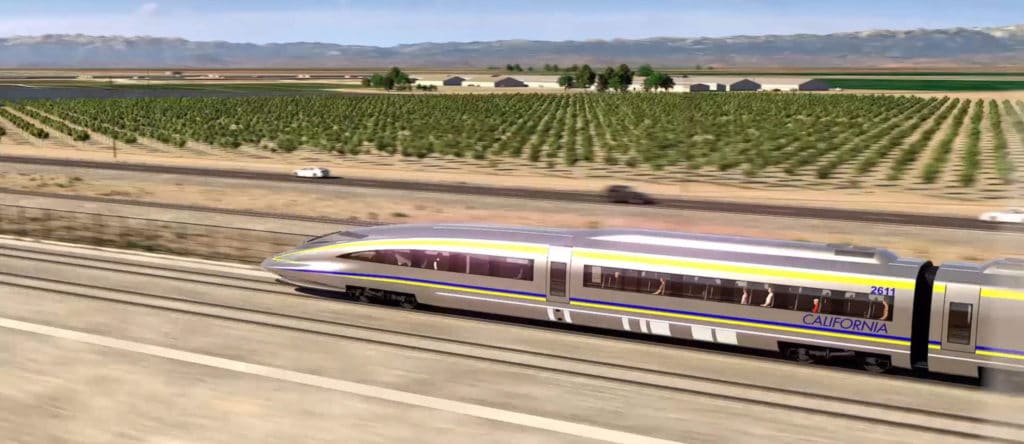
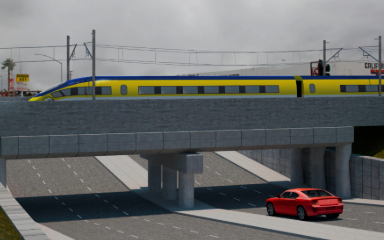
STV helped the California High-Speed Rail Authority (Authority) reach a defining milestone: approval of the Final Environmental Impact Report (EIR) and Combined Final Environmental Impact Statement (EIS)/Record of Decision (ROD) for the Los Angeles-to-Anaheim section and completion of environmental clearance for the entire 494-mile Phase 1 rail system connecting San Francisco to Los Angeles and Anaheim.
For STV, the milestone also represents the culmination of nearly two decades of planning and environmental work on the program’s southernmost Phase 1 section. Since 2007, STV has served as Authority’s prime consultant for the Los Angeles-to-Anaheim corridor, leading project management and preparing engineering and environmental documentation, culminating in the Final EIR/ROD.
“This is a significant milestone not only for the Los Angeles-to-Anaheim section, but for California’s entire high-speed rail program,” said Tyler Bonstead, vice president and planning lead at STV. “Completing environmental clearance for Phase 1 reflects years of complex planning, engineering and collaboration across the state. For our team, it’s especially meaningful to see nearly two decades of work on this corridor help move the Authority toward the next stage of the program.”
Nearly Two Decades of Planning in Southern California
The Los Angeles-to-Anaheim section will connect Los Angeles Union Station with the Anaheim Regional Transportation Intermodal Center (ARTIC), establishing the southernmost link of Phase 1 of the statewide high-speed rail system.. STV’s work on the corridor integrated a wide range of engineering plans, environmental analyses, technical studies, and agency coordination across multiple stakeholders to advance project delivery.
The work extended well beyond the scale of the documentation. The corridor is one of the country’s busiest for passenger and freight rail, requiring planners to determine how high-speed rail could be introduced largely within an existing rail right-of-way while minimizing impacts to surrounding communities and existing operations.
“These tracks move more people and goods than almost anywhere else in the country, and this milestone shows how high-speed rail can make that system stronger,” Bonstead said. “By building on existing rail infrastructure, the program advances high-speed rail while limiting impacts to surrounding communities and existing rail operations.”
STV’s Final EIR/ROD builds on the Draft EIR/EIS released in December 2025 and incorporates responses to public and agency comments, design refinements and updates to environmental impacts and mitigation measures.
Helping Advance High-Speed Rail Across Southern California
In addition to the Los Angeles-to-Anaheim section, STV also served as prime consultant for the environmental review of the 14-mile Burbank-to-Los Angeles project section, which received environmental approval in 2022. That corridor connects a planned Hollywood Burbank Airport station with Los Angeles Union Station and includes what is planned to become the nation’s first direct high-speed rail connection to a major airport.
Similar to the Los Angeles-to-Anaheim project, planning for Burbank-to-Los Angeles required STV to address the challenge of introducing high-speed rail within a constrained urban corridor already used by Metrolink, Amtrak and Union Pacific. At the time of its environmental approval, more than 100 trains operated through the corridor each day.
Together, the two assignments have given STV direct experience addressing the environmental, engineering and operational challenges of integrating high-speed rail into active, constrained rail corridors through the busiest areas of Southern California.
Continuing a Long-Standing Partnership
While the Los Angeles-to-Anaheim approval closes an important chapter of STV’s work, the firm’s relationship with the Authority continues.
In the Central Valley, STV is leading environmental review and preliminary engineering for the Authority’s proposed Central Valley Heavy Maintenance Facility (HMF), which would serve as the primary location for inspecting, servicing, maintaining and overhauling California’s future high-speed train fleet.
“Our involvement with California high-speed rail has always been about solving the next challenge in front of the program,” Bonstead said. “Reaching environmental clearance across Phase 1 is a tremendous accomplishment, and we’re excited to continue bringing the experience we’ve built over nearly two decades to the next stages of this transformative program.”