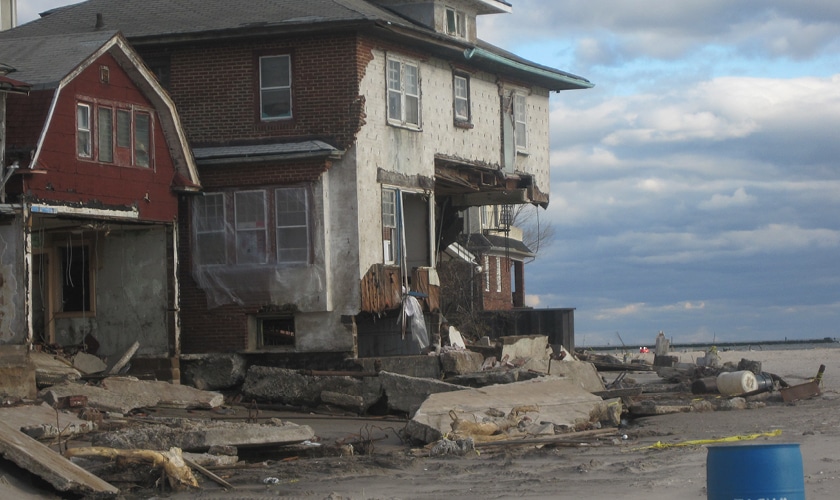
Health systems are navigating rising construction costs, aging facilities and evolving reimbursement models, all while facing increasing pressure from extreme weather, grid instability and regulatory requirements. Owners are being asked to deliver uninterrupted care in an increasingly volatile operating environment – often while serving as critical community anchors during emergencies and extended outages.
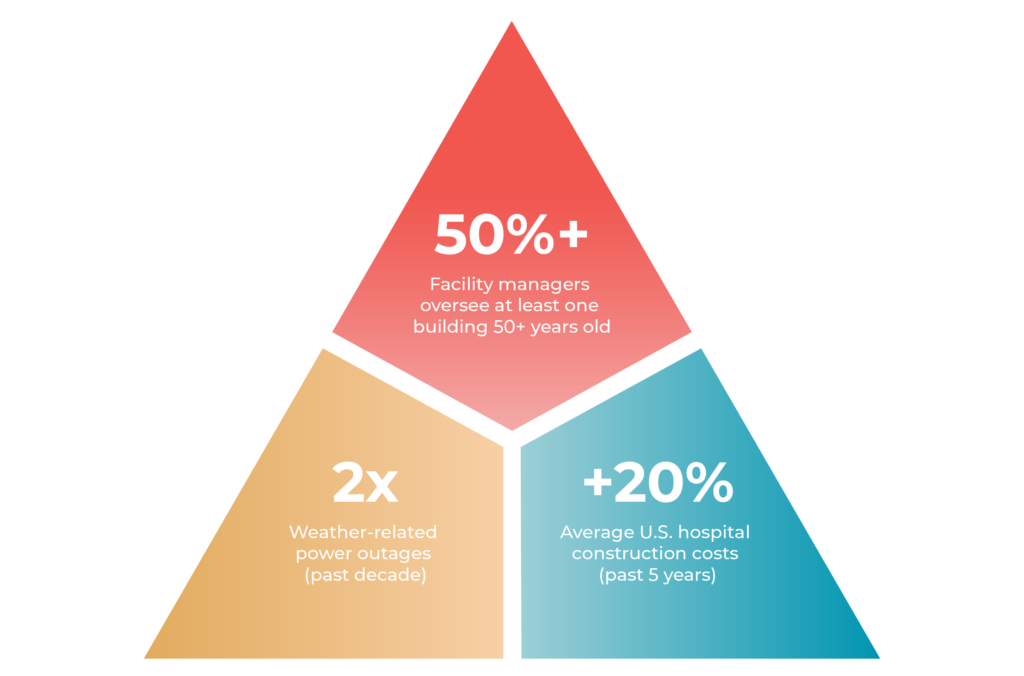
In these conditions, hospitals are reexamining how patient-centered projects are financed – moving beyond single-purpose capital investments toward infrastructure strategies designed to deliver multiple, measurable value streams across operational, financial, resilience and community outcomes over time.
This shift reframes infrastructure not as a cost center, but as a strategic lever; one that supports clinical continuity, protects patients and keeps essential services available to communities when they are needed most, while strengthening long-term financial performance simultaneously.
Annabel Cryan, director of innovative finance strategies at STV, brings deep experience supporting public sector and healthcare clients in advancing complex infrastructure projects in capital-constrained environments. By aligning creative financing tools with operational priorities and long-range planning – and translating clinical risk, reliability needs and disruption exposure into financeable project value – she helps organizations move critical projects forward without losing sight of public health, resilience and accountability.
In this interview, Cryan explores how unlocking multiple value streams enables hospitals and healthcare systems to advance critical infrastructure investments while safeguarding clinical operations, patient outcomes and long-term financial health.
1. When hospitals are facing limited capital, where do you see the biggest opportunity to rethink infrastructure investment?
The biggest opportunity is changing the initial question from “How do we fund this?” to “What value can this investment deliver over its full lifecycle?” In healthcare, infrastructure decisions have a direct and immediate impact on patient safety, clinical operations and access to care.
Over time, the project may bring additional benefits that can materialize on the balance sheet and serve as an investment rationale. When the value is clearly defined early, elements that support resilience or efficiency are less likely to be value-engineered out and more likely to be protected as essential.
When hospitals design projects to capture multiple value streams – from operational performance and financial stability to resilience and community continuity – they’re investing in outcomes that support the organization long after construction is complete.
2. What does “multiple value streams” mean in a hospital setting, specifically?
In healthcare, multiple value streams show up in very tangible ways. Energy efficiency upgrades can reduce operating costs and free up resources for patient care. On-site renewable energy generation or battery storage can reduce reliance on the grid and, in some cases, create predictable financial returns through tax credits or Power Purchase Agreements (PPAs).
Resilience measures, such as protecting critical systems and ensuring power continuity, help prevent service disruptions that could compromise clinical outcomes – and enable hospitals to remain operational for their communities during prolonged outages or extreme events. There’s also a financial dimension: reducing downtime, avoiding evacuations and protecting revenue-generating departments like operating rooms or imaging suites.
When these risks are mitigated, hospitals often strengthen their overall financial profile, which can influence borrowing capacity, cost of capital and even insurance considerations. In many cases, resilience investments are recognized as risk-reduction measures during insurance reviews, with the potential to reduce premiums.
3. Energy efficiency is often framed as a sustainability initiative. How does it tie back to healthcare operations and finance?
Energy efficiency is one of the most direct value streams for healthcare. Hospitals are among the most energy-intensive facilities, and even incremental improvements can produce meaningful, recurring savings. Those savings directly support the hospital’s mission by easing pressure on operating budgets and preserving resources for patient care.
From a finance perspective, predictable reductions in utility costs can help support certain financing structures or strengthen the business case for broader upgrades. Through Direct Pay, nonprofit systems can leverage ITC and PTC tax credits for on-site or off-site energy generation and/or battery storage systems. Hospitals can also access lower-cost or alternative capital through tools such as CPACE financing or partnerships with local Green Banks.
Operationally, efficient systems are often more reliable: supporting continuity of care and strengthening resilience for the communities hospitals serve.
4. How does this approach change the way project teams can work?
The question project teams need to ask is: What is the cost of disruption? When we can quantify the cost of disruption (and its avoidance), resilience investments start to look less like an added expense and more like a form of risk management with a measurable return.
When clinical, project and finance teams are aligned around shared outcomes, hospitals are better positioned to prioritize projects that deliver the greatest overall value. That alignment is often what determines whether a project stalls or moves forward despite capital constraints.
At STV, integrating design, engineering and finance expertise early allows us to help hospitals stretch limited capital while protecting what matters most: patient care, clinical continuity and the hospital’s role as a trusted, reliable resource for the communities it serves.