Spanning a tidal salt marsh in north Jacksonville, for decades, the twin bridges carrying U.S. 17 (North Main Street) over the Broward River have served as a key link for commuter traffic, freight movement and local access, between the city’s downtown and its northern neighborhoods. By the present day, both were structurally deficient and functionally outdated, lacking shoulders and safe pedestrian access, and no longer meeting modern design standards.
To enhance the long-term safety and reliability of this crucial route, the Florida Department of Transportation (FDOT) launched a $14 million bridge replacement project. Working closely with FDOT, STV led the design and engineering effort to deliver a modern solution that would enhance mobility, improve safety and protect the surrounding environment.
Transforming U.S. 17 for Today’s Travel Needs
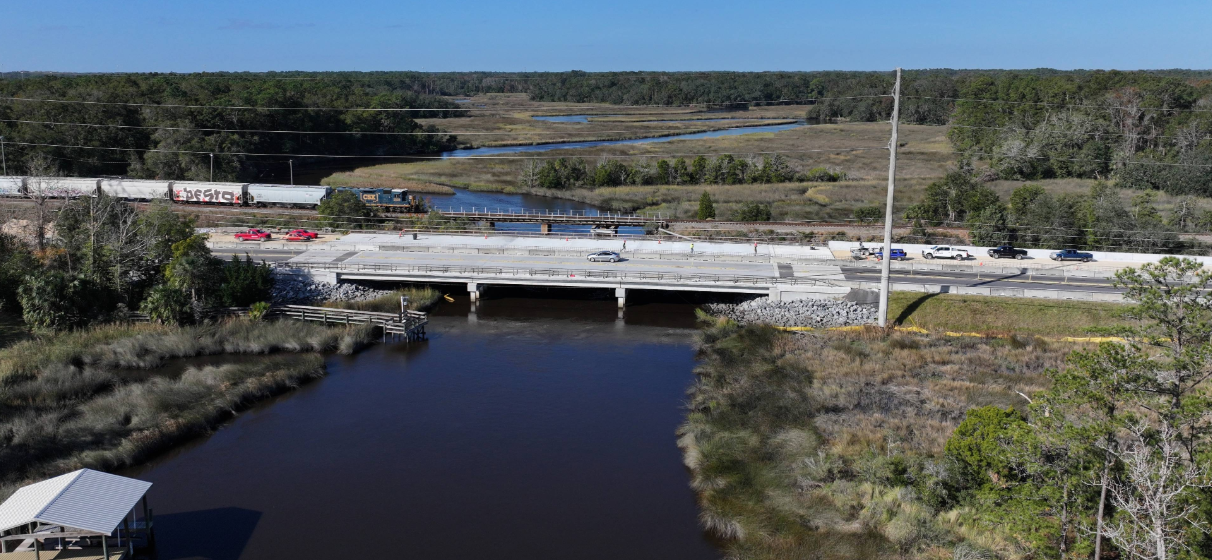
STV’s design replaced the two outdated bridges with a single, widened, three-span bridge that still carries the four travel lanes. The new structure includes a concrete median barrier, a sidewalk on the east side and a dedicated bicycle lane – features absent from the original configuration and that respond directly to long-standing safety and access limitations along the corridor.
By consolidating bridges, the design simplifies maintenance, eliminates redundancy and improves safety and multimodal access, while creating a more consistent and predictable driving experience for the nearly 20,000 motorists who use the route daily.
“North Jacksonville is growing, and U.S. 17 is a vital artery for the community,” said Keith Jackson, PE, senior vice president and Florida district manager at STV. “By replacing these aging bridges with a modern, resilient span, we’ve dramatically improved safety and mobility. The new structure works better for everyone who depends on it – drivers, pedestrians and cyclists alike.”
Building Resilience in a Sensitive Coastal Setting
The project’s location in a coastal salt marsh and floodplain introduced unique challenges. The Broward River is tidally influenced, and the low elevation of the original bridges made them vulnerable to storm surge and flooding. STV’s structural engineers determined the optimal bridge profile by accounting for coastal hydraulics and wave height, using these analyses to inform deck elevations and approach geometry, so that the new structure was designed to withstand extreme weather while minimizing the need for extensive approach ramps that would encroach on wetlands.
“We recognized early on that the Broward River’s salt marsh environment demanded careful stewardship,” Jackson said. “Our team engineered solutions to minimize our footprint – even eliminating the need for a temporary detour bridge – so construction could proceed while limiting disturbance to sensitive areas.”
Environmental monitors oversaw wetland protection measures, and the design closely followed the existing alignment to limit new disturbance. Drainage patterns, access routes and staging areas were also carefully evaluated to support environmental compliance throughout construction. The result is a bridge that is both resilient and environmentally responsible.
Designing Around Rail, Utilities and Tight Right-of-Way
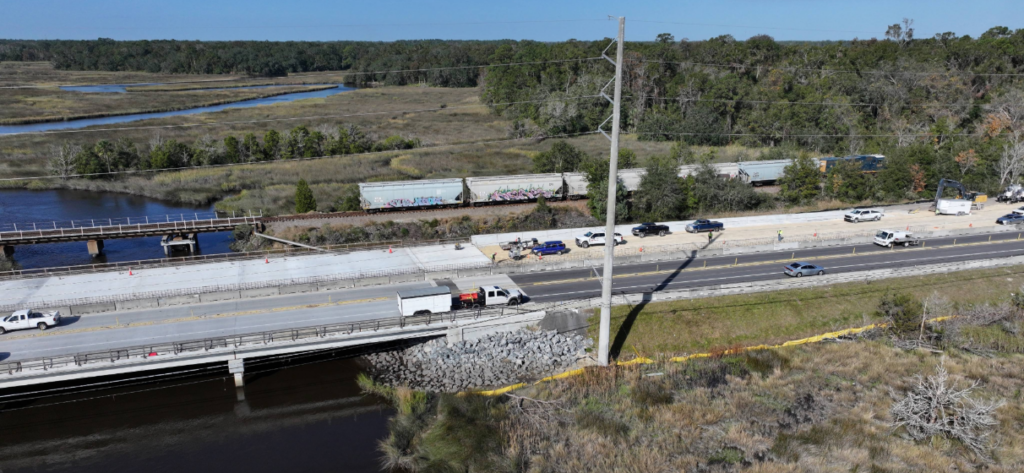
Constructing a new bridge in a constrained corridor required innovative thinking and extensive early coordination. A CSX Transportation freight line runs immediately west of the bridge, with trains crossing their own trestle just yards away. The original bridges sat partly on CSX property, necessitating close coordination and compliance with railroad setback requirements.
Early alignment studies and right-of-way evaluations led STV to propose shifting the alignment slightly east, away from the tracks. STV’s knowledge of CSX public projects review process allowed us to address all CSX concerns and design the bridge and roadway improvements to maintain harmony with the railroad.
“From day one, we collaborated closely with FDOT, CSX, local utilities and the community to address their concerns,” Jackson said. “Through that partnership, we shifted the roadway alignment to meet railroad needs and avoid utility disruptions, while keeping the project on track.”
Utility conflicts added another layer of complexity. A pressurized waste pipeline owned by the nearby Anheuser-Busch brewery ran parallel to the road, along with overhead high-voltage transmission lines. STV’s design avoided relocating these utilities by carefully positioning bridge piers and planning crane operations to maintain safe clearances, reducing risk and minimizing service interruptions.
Delivering Construction While Keeping Jacksonville Moving
With U.S. 17 serving as a key commuter and freight route, maintaining traffic flow during construction was a top priority. STV developed a phased maintenance of traffic (MOT) plan that kept at least one lane in each direction open throughout construction, allowing travelers to maintain reliable access through the corridor.
Initially, traffic was shifted onto one of the existing bridges while the other was demolished. Once a portion of the new bridge was complete, traffic was moved onto the new span, allowing the remaining old bridge to be removed. This carefully sequenced approach reduced congestion and preserved predictable travel patterns.
Though a temporary diversion bridge was considered, STV’s refined MOT strategy eliminated the need for it, reducing environmental impacts, utility conflicts and project costs. The result was a construction process that minimized disruption for the community while maintaining access to homes, businesses and industrial facilities, even during peak travel periods.
Delivering Long-Term Mobility and Regional Growth
The Broward River Bridge Replacement delivers wide-ranging benefits. Safety is significantly improved with modern design standards, including crash-tested barriers and wider lanes. The addition of pedestrian and bicycle facilities enhances connectivity and supports multimodal transportation. The bridge’s flood-resilient design ensures continued access during severe weather, and its consolidated structure reduces long-term maintenance needs.
“Our goal was not just to replace a bridge, but to elevate an entire corridor’s reliability,” Jackson said. “This project shows how innovative engineering can solve complex challenges – protecting the environment, working with multiple stakeholders and ultimately improving daily life for the community.”