
The Better Question is a recurring series that grounds complex industry assumptions in facts, feasibility and community impact.
Benefit-cost analyses are designed to answer a simple question: Is a project worth the investment? Yet in practice, they often measure value based on existing travel patterns, overlooking the people and trips that could emerge if barriers to participation were lowered or eliminated.
Across the United States, people miss work shifts, delay medical care, turn down education opportunities, skip daily errands, or miss out on recreational and social opportunities because transportation infrastructure is too unreliable, too expensive or simply unavailable. Economists refer to those unmade trips as “latent demand.” For communities and agencies, those missed trips represent more than an abstract concept – they reflect lost participation and unrealized economic activity. Those foregone trips (and the economic activity they would have generated) never appear in traditional models. When trips never happen, their value remains invisible in the analyses used to guide investment decisions.
In this edition of The Better Question, STV’s infrastructure economics team draws on its work with agencies nationwide to outline how measuring Potential Trip Value (PTV) helps communities better understand the full, participation-driven economic return of transportation investments that reduce barriers to participation.
Myth: Transportation projects only create value for existing travelers by making existing trips faster, more reliable or safer.
Where did this perception come from, and why does it persist?
Current ridership models are built around evaluating trips that already occur: existing users and travelers who shift modes after an investment. Trips that never happen because transportation barriers prevent participation are excluded from the baseline scenario, which defines the conditions that are expected without the transportation investment.
Because these suppressed trips are not visible in the models, their economic value goes unmeasured. Over time, this has shaped how benefits are understood, compared and prioritized – systematically understanding the value of access-focused investments. That blind spot persists today, making it harder for agencies to justify, fund and advance projects that reduce barriers in communities with unmet (latent) travel demand.
What does the actual evidence show?
The evidence consistently shows that transportation barriers suppress real economic activity, and that when those barriers are reduced or eliminated, newly enabled trips generate measurable economic value.
Research across labor markets, healthcare access, education and daily mobility demonstrates that limited transportation access reduces workforce participation, delays or prevents medical care, lowers educational attainment and constrains consumer activity. These impacts represent opportunity costs to individuals and to the broader economy.
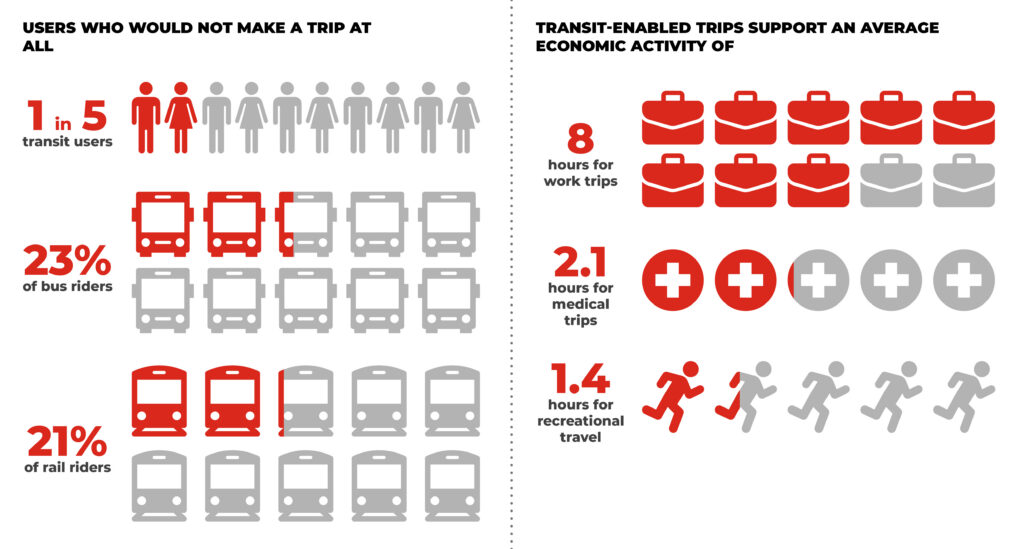
Limited transportation access is associated with lower workforce participation, poorer health outcomes, reduced educational attainment and constrained consumer spending, particularly in communities facing affordability, reliability or geographic barriers.
when STV applies existing United States Department of Transportation’s benefit–cost analysis guidance to these newly enabled trips shows that even a relatively small share of suppressed trips can generate a disproportionate share of total economic benefits once access is improved.
When transportation investments reduce barriers and enable participation, the resulting economic value is real, observable and grounded in existing data and accepted economic practice.
How has STV evolved benefit-cost analysis to better reflect real‑world access?
STV developed the Potential Trip Value (PTV) in response to a recurring challenge we see in practice: traditional return-on-investment metrics systematically undercount the value of improved access.
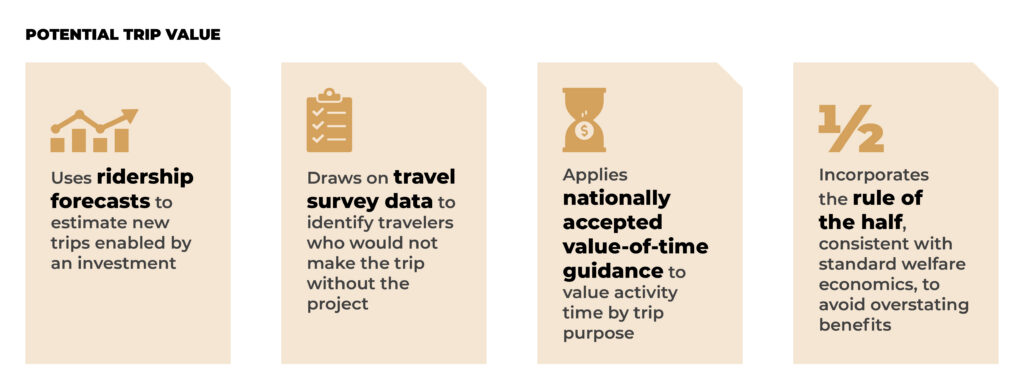
Because PTV follows the same economic logic already accepted in federal guidance, its results can be directly compared with other benefit categories and incorporated into alternatives analyses, funding applications and project prioritization decisions.
Most importantly, PTV helps agencies connect technical analysis to real-world outcomes – showing how investments translate into participation, opportunity and economic returns.
What does this look like in practice?
For a recent high-capacity transit study in Virginia, STV’s ridership economic analysis showed that only about 4 percent of total trips enabled by expanded transit service were entirely new trips that would not have occurred without the investment. Despite their small share, those trips accounted for roughly one-quarter of the projects’ total annual economic benefits: about $14 million.
Although these trips represented a small percentage of new riders, they generated a disproportionate share of total value because they enabled participation that did not exist in the baseline: work shifts taken, medical appointments kept and daily activities completed for the first time.
The result was a strong return on investment of $2.10 in benefits for every $1 invested, materially strengthening the economic case for the project and informing how its benefits were understood by decision-makers.
If stakeholders are debating whether transportation investments truly deliver value, what question should they be asking?
Instead of solely asking:
“Do enough people use this service today to justify the investment?”
Ask:
“How much additional economic value is created when transportation makes participation possible for the first time?”
That shift in framing is where PTV adds clarity. It reframes PTV reframes how communities evaluate transportation investments – making the benefits of access visible, measurable and defensible. Ultimately, this helps agencies compete for funding by better representing the full value their projects deliver.
Some trips may be small in number, but when they unlock participation, their value is anything but.
Find out more about how STV’s Infrastructure Economics and Grants Advisory team partners with agencies to evaluate access, opportunity and return on investment to align with long-term community goals.