Many transit agencies’ first major encounter with Federal Transit Administration (FTA) safety certification comes after a major capital project is already funded, exposing gaps in understanding and pressure on budgets and schedules. When certification is introduced late, these gaps often translate into design rework, delayed approvals and operational misalignment that can ripple across procurement, construction and readiness efforts. As a result, impacts on project quality can delay or derail FTA approval for revenue service.
In this edition of The Better Question, Tom Lentz, vice president and safety and security development director, outlines why FTA safety certification continues to surprise agencies decades after it became a requirement and what transit leaders can do before their next capital project enters design.
Myth: “Safety certification is a straightforward, uniform process that doesn’t significantly impact project scope or delivery.”
Where did this idea come from, and why does it still stick?
Many agencies (particularly small and mid-sized organizations or those early in adopting Safety Management Systems (SMS)) have never crossed the FTA funding thresholds that trigger this requirement. As a result, they often lack direct experience with the full certification process. At the same time, certification has been framed to help reduce rework, improve acceptance and proactively identify risks earlier in the lifecycle – when changes are less disruptive and less costly.
However, when these considerations are not fully integrated, agencies can face late-stage design revisions, testing delays and challenges aligning infrastructure decisions with long-term operations.
This perception is also influenced by the aviation industry, which successfully applied certification principles to reduce safety incidents and has long been recognized as a leader in safety performance. Building on that model, the FTA adopted safety and security certification in the late 1990s and later formalized its role for capital projects as a component of SMS programs.
Over time, certification has gained broader acceptance because, when applied and managed correctly, it serves as a coordinated framework for aligning design, construction and operational intent across the entire lifecycle of project elements. Done well, it enables smoother approvals, more predictable delivery and stronger operational readiness at launch. It ultimately strengthens safety and security for both those responsible for project delivery and for end users and the public, despite the misconception that the process itself is simple.
How has STV evolved its approach as the landscape has changed?
While the current guidance for safety and security certification (released in 2001) remains a valuable resource, it has limitations. The process outlined was developed with a relatively straightforward design-build project in mind, reflecting the standard engineering delivery models of that time.
Since then, the landscape has become significantly more complex. The rise of Public-Private Partnership (P3) contracts, more varied delivery models such as design-bid-build and progressive design-build, and large capital programs involving multiple packages and broad stakeholder groups all require adaptation and customization of the original 2001 guidance. Applying that guidance effectively today often requires additional explanation, collaboration and alignment with clients and both internal and external stakeholders. Without that alignment, certification can become fragmented – leading to inconsistent documentation, gaps in accountability and risk exposure that surfaces late in the delivery process.
For transit agencies with limited certification experience, this evolution can be challenging and, at times, lead to project risks or misalignment. In response, STV works with agencies as an integrated partner to align certification strategy with project delivery from the outset – connecting planning, design, construction and operational priorities into a cohesive approach.
STV addresses this by tailoring the certification process to the specific project delivery model, as well as to project limits and constraints. This includes:
- Early engagement: Aligning safety and security regulatory requirements with project delivery strategies early in planning and established agency SMS and Certification standards
- Collaboration -first delivery: STV actively collaborates with and guides the client and stakeholder teams, ensuring stakeholders understand requirements and their operational implications and how they carry across phases.
- Risk-forward decision-making: Integrating qualitative and quantitative analysis for hazard and vulnerability identification, mitigation and verification so risks are addressed early rather than driving late-stage design changes or testing delays
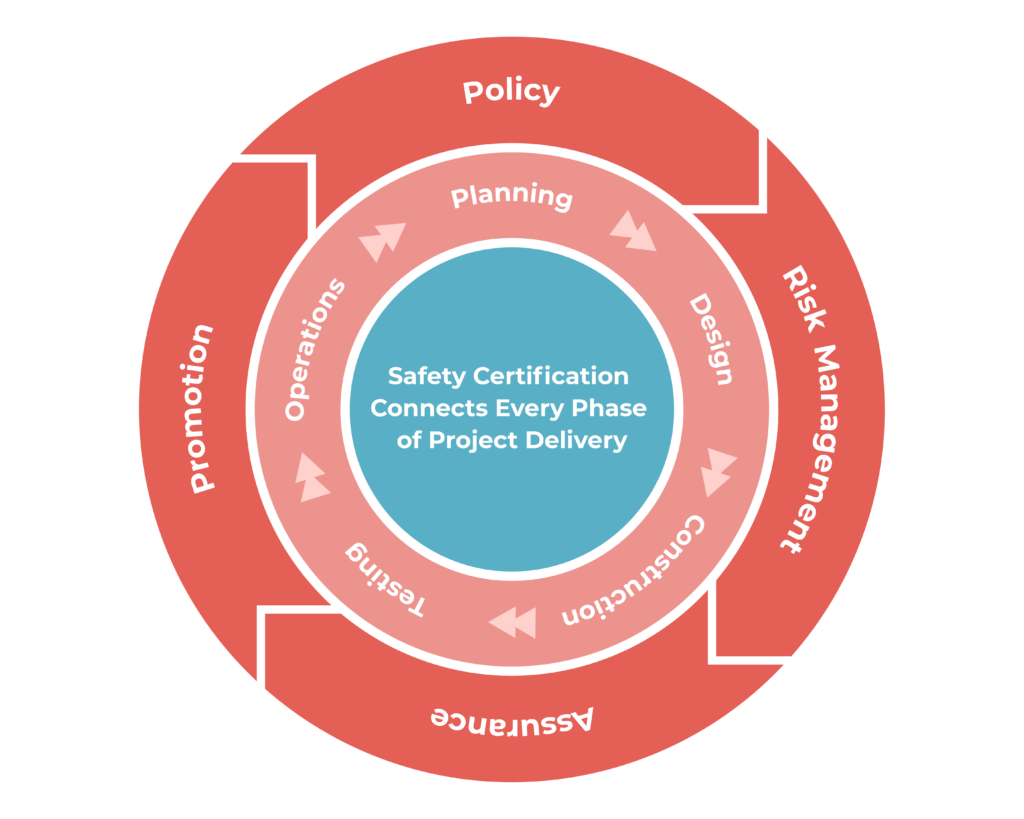
- Consistent documentation: Traceability across all project phases from planning, design, construction, testing and acceptance, pre-revenue preparation and operational readiness, reducing gaps in documentation that can delay approvals or create misalignment at handover
What does this look like in practice?
STV helps transit agencies move to SMS Programs that support regulatory compliance, providing accountable, resilient safety and security cultures with clear lines of responsibility and reasonable and prudent risk management decision-making.
For example, on large, multi-package programs or projects delivered through P3 structures, certification must be coordinated across multiple designers, contractors and stakeholders – each operating on different schedules and priorities. In these environments, early alignment on certification expectations and continuous coordination can help avoid conflicting design decisions, gaps in documentation and delays in testing and acceptance that might otherwise emerge late in delivery.
While agencies are determining where safety certification fits into their project workflow, what question should they be asking?
Instead of asking:
“Does safety certification actually change how we design or deliver the project?
Agencies should be asking:
“What can safety certification offer to align our project with long‑term operational needs?”
This shift recognizes that certification is not simply a compliance requirement, but a tool for shaping how systems perform once they are in service – supporting safer operations, more reliable infrastructure and greater confidence for both operators and riders.
By integrating safety certification as a lifecycle‑driven discipline that can influence design, operations and long‑term system performance, agencies can answer deeper, more strategic questions that shape both project delivery and the system’s accountability years into the future. Ultimately, this approach strengthens not only project outcomes, but also the long-term resilience of transit systems, the safety of the traveling public and the trust that communities place in the infrastructure they rely on every day.
Find out more about how STV’s safety and security team supports feasible, federally compliant, and future‑ready safety and security strategies for transit systems of every scale.