As global events like the FIFA World Cup and the upcoming LA28 2028 Olympic and Paralympic Games in Los Angeles scale in size and ambition, so do the expectations placed on host city infrastructure. Nowhere is that pressure felt more acutely than in transportation, where systems must flex to absorb sharp, time‑bound surges in demand across venues, modes and geographies – while continuing to serve the daily needs of residents and creating a reliable, accessible experience for visitors and communities alike.
For decades, planning for these events has relied on static forecasts and historical assumptions. But a more advanced model is emerging – one that reflects how infrastructure must perform today: dynamic, connected and informed by real data. Predictive mobility, enabled by digital infrastructure, allows agencies to move from reacting to demand to anticipating it – giving operators, planners and decision-makers the ability to act earlier and with greater certainty in high-pressure environments.
Event schedules, venue capacities, and historical attendance often exist in isolation. Bringing these inputs together enables agencies to translate this fragmented information into a clear picture of how systems will perform under pressure – informing how service is prioritized, how capacity is staged and how operational plans are sequenced across complex, multi-venue environments.
Using data from a previous Olympic Games for a recent project, STV’s team applied statistical and time-series analysis to identify how many people would travel, when demand would peak and where strain would occur. That analysis provided a time-based view of system pressure that enabled stakeholders to identify critical decision points – when to increase service, where to deploy resources and how to manage system performance during peak demand windows. It also helped reduce the risk of system overload by clarifying where and when intervention would be required to maintain reliability.
Yet understanding when demand peaks is only part of the equation. To support real-world decision-making, that insight must be grounded in how people actually move through the system – and how those movements translate into operational demands across the network.
By integrating time-based analysis with geospatial mapping, STV created a unified view of event activity, transportation networks and capacity constraints. This allowed agencies and operators to:
- Track how crowds would move between venues and across the broader network
- Understand how demand distributes across rail, bus and first/last-mile connections to inform service planning and resource allocation
- Identify where and when congestion would occur across the network so that mitigation strategies could be implemented in advance rather than in real time
Bringing these elements together turns analysis into action – creating a shared understanding of system behavior over time and across space that supports coordinated decision-making across agencies, operators and stakeholders.
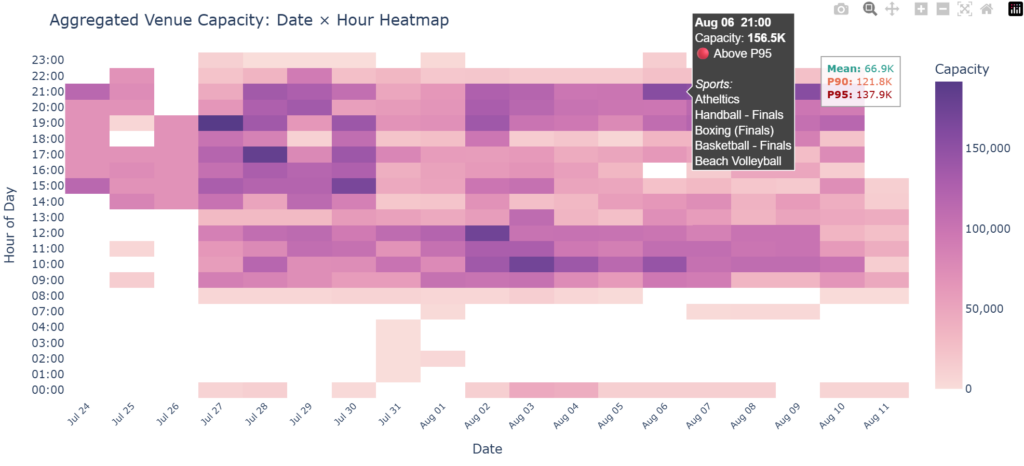
For events where timing is unforgiving and margins for error are narrow, this level of precision is essential. It reduces risk, improves reliability and allows systems to operate as intended, even under peak demand – ensuring that both event attendees and everyday riders experience consistent, dependable service.
As global events continue to grow in complexity, so must the systems that support them.
Predictive mobility is redefining how infrastructure is planned, managed and delivered – shifting the focus from reacting to conditions to shaping outcomes. By connecting data, engineering expertise and operational insight, it allows agencies to act earlier, respond faster and deliver a more reliable experience for the communities and visitors they serve.
At its core, predictive mobility reflects what effective infrastructure must deliver today: reduce uncertainty, strengthen performance and create confidence in moments where it matters most – equipping decision-makers with the clarity and judgement needed to operate complex systems under pressure.